
news | Monday June 1, 2026
Indigenous History Month 2026
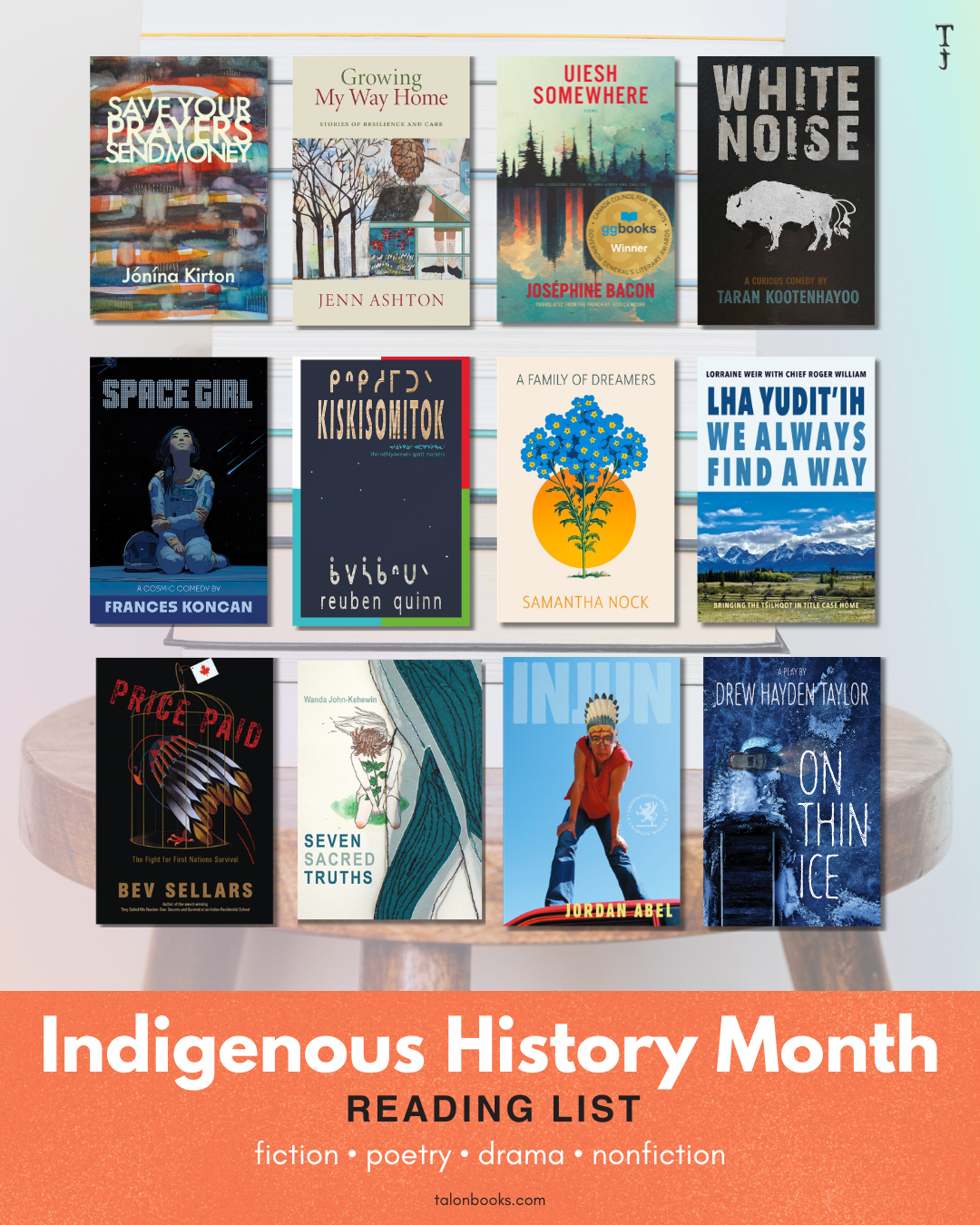
June is Indigenous History Month! We’re fortunate at Talonbooks to have the opportunity to publish a growing roster of Indigenous authors, playwrights, poets, visual artists, activists, humorists, and more. If you want to mark the occasion with a book to immerse yourself in a myriad of Indigenous perspectives, we’ve put together a reading list of some truly excellent titles that range from personal to public, funny to unsettling, and deep to the whimsical. Check it out below.
1. Save Your Prayers – Send Money by Jónína Kirton

This brand new poetry-and-prose collection by seventy-year-old Métis woman and recovering New Ager Jónína Kirton takes on the wellness industry. Save Your Prayers – Send Money is a book for all interested in intersectional Disability justice. Learn more about both Kirton and her new title in this interview on Windspeaker.org. Save Your Prayers – Send Money is also Black Walnut Books’s Indigenous & Lit Book Club pick for their July 19 session, check out all of their book club picks here. Frank, warm, angry, and witty, pick up your copy of Save Your Prayers – Send Money here.
2. Growing My Way Home by Jenn Ashton

In the new work of autofiction Growing My Way Home by award-winning Sḵwx̱wú7mesh author, visual artist, filmmaker, and historian Jenn Ashton, we follow one woman’s struggle through events all too common among a people who have been separated from their culture and their language. Based on Ashton’s teenage journals, we follow our protagonist as she recounts abuse, early involvement in the criminal justice system, her experiences as a thirteen-year-old drug dealer, a fifteen-year-old parent, and then finally an award-winning multidisciplinary artist. Growing My Way Home was one of CBC Books’ list of fiction titles they’re excited about this spring. Get a copy of your own here.
3. Uiesh / Somewhere by Joséphine Bacon, translated by Jessica Moore
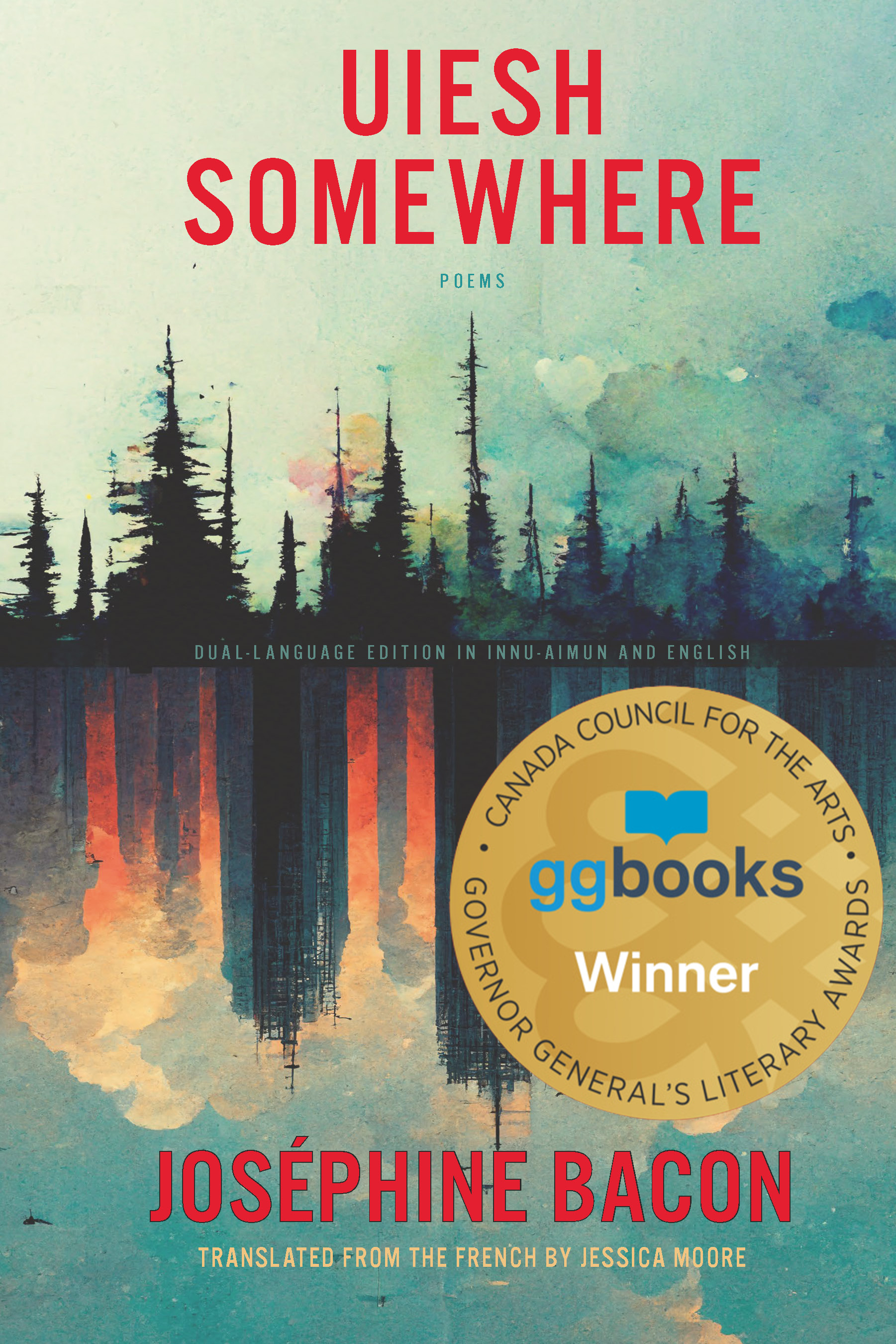
Uiesh / Somewhere is an award-winning, dual language collection where poems appear side-by-side in Innu-aimun and English. This title is a finalist for the 2026 Pat Lowther Memorial Award (read about all of the finalists here) and the winner of the 2025 Governor General’s Literary Award for Translation (see all of the winners here). Evocative, reflective, and unforgettable, the poems in Uiesh / Somewhere are rooted in Innu Elder Joséphine Bacon’s experiences of moving between the nomadic ways of her Ancestors in the northern wilderness of Nitassinan and the clamour of the city. Order your copy of Uiesh / Somewhere here.
4. White Noise by Taran Kootenhayoo

White Noise is a new dark comedy play by the late, great Taran Kootenhayoo. Originally produced by Savage Society and Firehall Arts, this laugh-out-loud drama follows two neighbouring families, one Indigenous and one white, as they dine together during Truth and Reconciliation Week. As cultural misunderstanding, colonial violence, and racism both covert and overt surface, White Noise asks how to navigate internalized racism. Featuring Pokémon, influencers, and a helpful little book entitled How to Deal with White People, this is a play that can’t be missed. Pick up your copy here.
5. Space Girl by Frances Koncan

Forthcoming this autumn is Space Girl: A Cosmic Comedy by Frances Koncan! As the first person born on the moon, Lyra lives a charmed life as a beloved social media influencer until her twenty-first birthday when two disasters strike: the birth of a rival “baby influencer” and the discovery of an enormous asteroid that threatens to destroy Earth (and all of her social media followers). Pre-order your copy here.
6. ᑭᐢᑭᓱᒥᑐᐠ kiskisomitok: ᓀᐦᐃᔭᐤ to remind each and one another by ᑳᐯᓵᑳᐢᑌᐠ reuben quinn
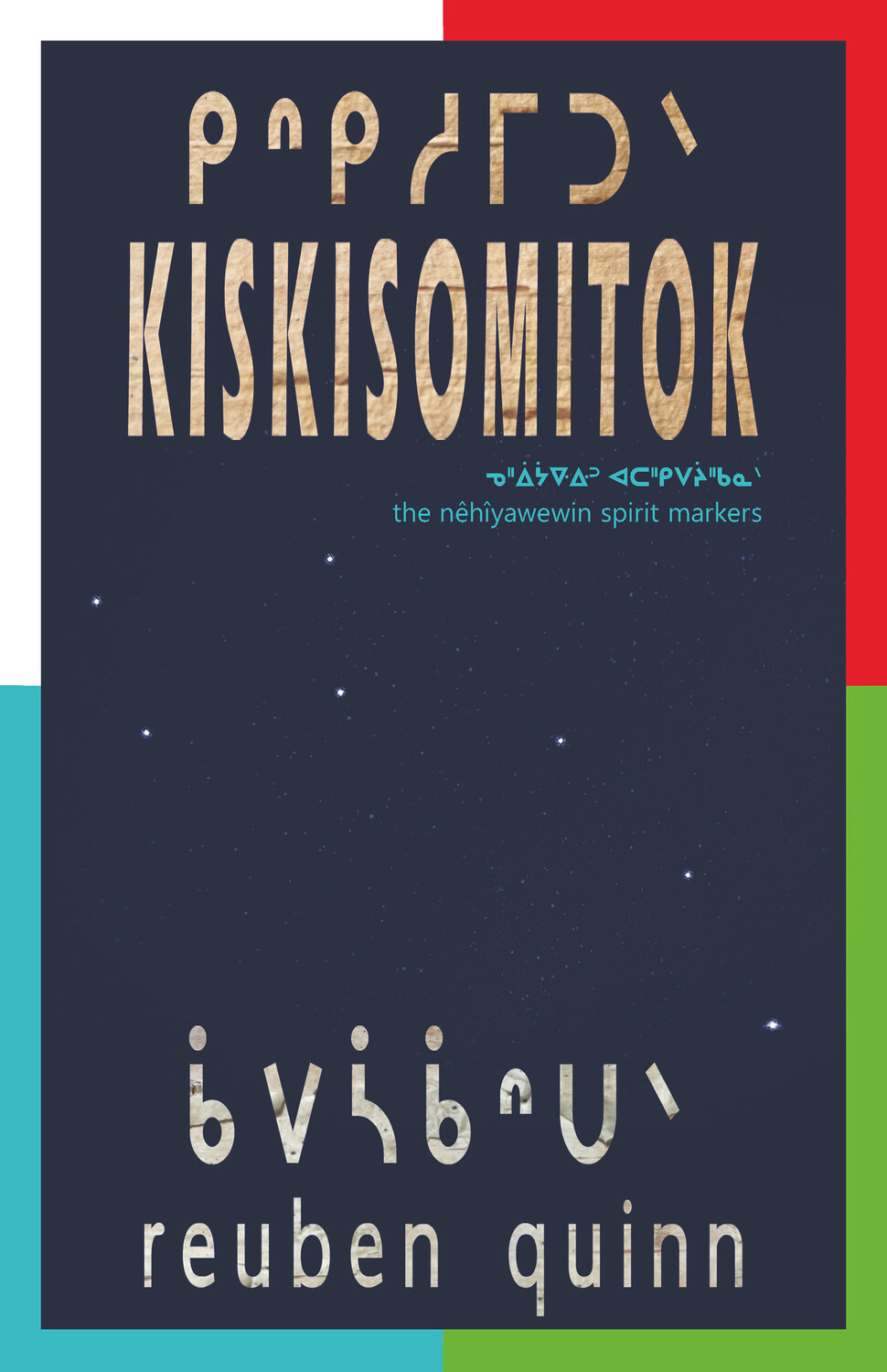
A finalist for the 2026 Wilfrid Eggleston Award for Nonfiction Book (view all of the finalists here) and the 2026 Indigenous Voices Award for Published Prose (see all of the finalists here), ᑭᐢᑭᓱᒥᑐᐠ kiskisomitok has been called “a major event for students and scholars of nêhiyaw ᓀᐦᐃᔭᐤ thought and communities” by Rob Jackson in Rocky Mountain Review. In ᑭᐢᑭᓱᒥᑐᐠ kiskisomitok: ᓀᐦᐃᔭᐤ to remind each and one another, nêhîyaw educator ᑳᐯᓵᑳᐢᑌᐠ reuben quinn uses the spirit marker writing system as a foundation for teaching ᓀᐦᐃᔭᐁᐧᐃᐧᐣ nêhîyawewin. Sometimes called the star chart, this system holds forty-four large spirit markers and fourteen small spirit markers. Each large spirit marker holds a law; these laws are meant to guide us in ways that support us in life, in living well with the elements: fire, land, water, and air. Copies are available here.
7. A Family of Dreamers by Samantha Nock

This gorgeous debut is a love song to northern cuzzins, dive bars, and growing up. Nock weaves together threads of fat liberation, desirability politics, and heartbreak while working through her existence as a young Indigenous woman coming of age in the city. A Family of Dreamers was a finalist for the 2024 Dorothy Livesay Poetry Prize and was longlisted for the 2024 Pat Lowther Memorial Award. Get your copy here.
8. Lha yudit’ih We Always Find A Way: Bringing the Tŝilhqot’in Title Case Home by Lorraine Weir with Chief Roger William

Winner of a 2026 Jeanne Clarke Local History Award (see the announcement here), Lha yudit’ih We Always Find A Way is a community oral history of Tsilhqot’in Nation v. British Columbia, the first case in Canada to result in a declaration of Aboriginal Rights and Title to a specific piece of land. Told from the perspective of the Plaintiff, Chief Roger William, joined by fifty Xeni Gwet’ins, Tŝilhqot’ins, and allies, this book encompasses ancient stories of creation, modern stories of genocide through smallpox and residential school, and stories of resistance including the Tŝilhqot’in War, direct actions against logging and mining, and the twenty-five-year battle in Canadian courts to win recognition of what Tŝilhqot’ins never gave up and have always known. Get your copy here.
9. Price Paid by Bev Sellars

Price Paid is based on a popular presentation Sellars created for treaty-makers, politicians, policymakers, and educators when she discovered they did not know the historic reasons they were at the table negotiating First Nations rights. Price Paid: The Fight for First Nations Survival begins with glimpses of foods, medicines, and cultural practices North America’s Indigenous peoples have contributed for worldwide benefit. It documents the dark period of regulation by racist laws during the twentieth century, and then discusses new emergence in the twenty-first century into a re-establishment of Indigenous land and resource rights. The result is a candidly told personal take on the history of a culture\‘s fight for their rights and survival. It is Canadian history told from a First Nations point of view. Order your copy here.
10. Seven Sacred Truths by Wanda John-Kehewin
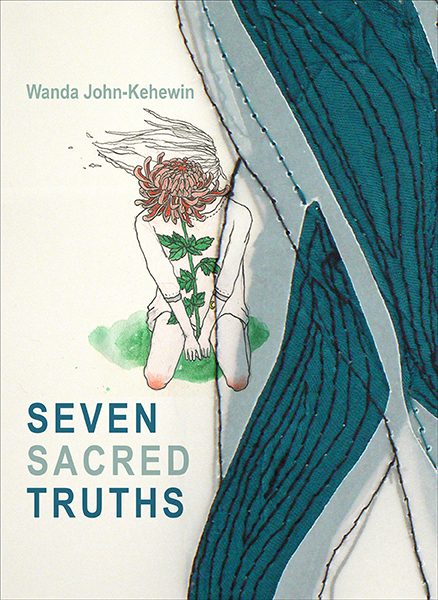
In Seven Sacred Truths, Wanda John-Kehewin makes new meaning of the past, present, and future through a consideration of Love, Wisdom, Truth, Honesty, Respect, Humility, and Courage. By sharing her views on these Seven Sacred Truths and what they meant to her growing up, John-Kehewin instigates a therapeutic process of restoration and transformation. Seven Sacred Truths was a finalist for the 2019 Indigenous Voices Award for Published Poetry in English. Get copies here.
11. Injun by Jordan Abel

Injun is a long poem about racism and the representation of indigenous peoples. Composed of text found in western novels published between 1840 and 1950 – the heyday of pulp publishing and a period of unfettered colonialism in North America – Injun then uses erasure, pastiche, and a focused poetics to create a visually striking response to the western genre. The textual explorations in Injun help to destabilize the colonial image of the “Indian” in the source novels, the western genre as a whole, and the Western canon.Injun won the 2017 Canadian Griffin Poetry Prize. Pick up your copy here.
12. On Thin Ice by Drew Hayden Taylor
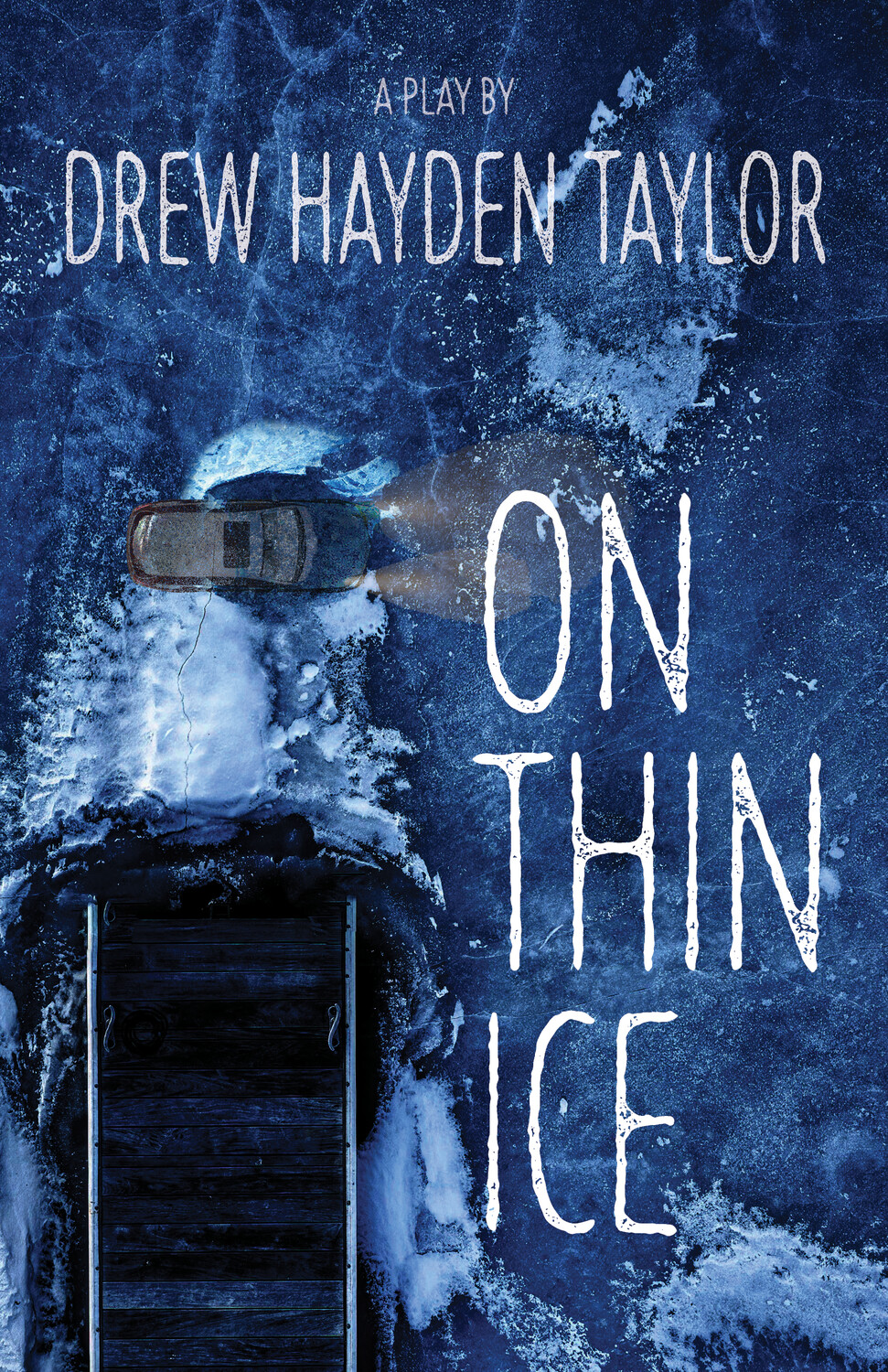
Forthcoming this fall is Drew Hayden Taylor’s first thriller, On Thin Ice. In this new play, an Indigenous couple makes their way to an isolated cottage after their car falls through an ice road on a cold winter evening. Suffering from hypothermia, they are saved by the arrival of the non-Indigenous cottage owners, one of whom is a nurse. Once the injured couple are resuscitated, the cottage owners discover that the “accident” was not necessarily accidental, and the histories and alternative agendas at play converge in a shocking and brutal ending. Pre-order your copy here.
These are just a slice of the amazing Indigenous-authored titles we’ve had the privilege to publish. Talonbooks also has an ever-updating Indigenous catalogue that we recommend perusing. We wish you good reading this month and all months.
News Archive
- Hajer Mirwali Wins the 2026 Trillium Book Award for Poetry!
- ᑳᐯᓵᑳᐢᑌᐠ reuben quinn Wins 2026 Wilfrid Eggleston Award!
- Save Your Prayers – Send Money in The Winnipeg Free Press
- Pride 2026 Reading List
- Hajer Mirwali Wins the Gerald Lampert Award!
- Crees in the Caribbean in The Niagara on the Lake Local
- Indigenous History Month 2026
- rob mclennan Reviews Pearl
- A Review of Behind the Moon in Sesaya Arts Magazine
- Three Talonbooks Authors on League of Canadian Poets Book Awards Shortlists!
- Hello from the CATR Conference!
- bissett Reading Covered in The Halifax Examiner
- bill bissett in The New Wark Times
- Shari Narine Interviews ᑳᐯᓵᑳᐢᑌᐠ reuben quinn
- rob mclennan Reviews sometimes, forest
- Four Talonbooks Titles on League of Canadian Poets Book Awards Longlists!
- Sharon Thesen Pens a Tribute to the Late Gladys Maria Hindmarch
- Revolutions Reviewed in Herizons
- Fire Never Dies: The Tina Modotti Project Has Arrived!
- Asian Heritage Month 2026
- ᑭᐢᑭᓱᒥᑐᐠ kiskisomitok: ᓀᐦᐃᔭᐤ to remind each and one another Shortlisted for Indigenous Voices Award for Published Prose
- An Interview with Jónína Kirton
- Hajer Mirwali Is a Finalist for the Trillum Book Award for Poetry!
- th book uv lost passwords 1 in The British Columbia Review
- Save Your Prayers – Send Money an Indigenous & Lit Book Club Pick!
- Kevin Loring on Global News
- Caroline Russell-King on Redeye
- Nicole Raziya Fong on All Lit Up
- Elee Kraljii Gardiner on North by Northwest with Margaret Gallagher
- Taryn Hubbard Named Chilliwack's Inaugural Poet Laureate!
- Hot Off the Press! Verbal Violence Is Here!
- Earth Day Reading List
- Reviews of Rose at the National Arts Centre.
- Jessica Moore on CBC Radio One
- Behind the Moon Garners Reviews
- sometimes, forest Has Landed!
- Tribute to Gladys Maria Hindmarch
- The Book of Z Named a Finalist for the 2026 Dorothy Livesay Poetry Prize!
- Hot Off the Press! Beautiful Unknown Future Has Arrived!
- Save Your Prayers – Send Money in The Tyee
- Poem by Jónína Kirton Read at the BC Legislature
- The Book of Z in The Winnipeg Free Press
- sometimes, forest Shouted Out in The New Quarterly Review
- Sarah Waisvisz in The Toronto Guardian
- Daphne Marlatt to Receive Honorary Degree
- Save Your Prayers – Send Money Has Arrived!
- You're Invited to the Talonbooks Spring 2026 Launch!
- ᑭᐢᑭᓱᒥᑐᐠ kiskisomitok is a Finalist for the 2026 Wilfrid Eggleston Award for Nonfiction!
- National Poetry Month 2026
- Alison Manley Reviews Crowd Source
- the berry takes the shape of the bloom in Arc Poetry Magazine
- Pearl Has Landed!
- Review of Convivialities in C Magazine
- Canadian Lambda Finalists in CBC Books
- Save Your Prayers – Send Money Featured on CBC Books
- World Theatre Day 2026
- Growing My Way Home Is Here!
- Hot Off the Press! SUBTEXT Has Arrived!
- th book uv lost passwords 1 longlisted for 2026 Al and Eurithe Purdy Poetry Prize
- World Poetry Day 2026
- Drew McEwan on bill bissett
- In Memoriam: Gladys Maria Hindmarch, 1940–2026
- Heartlines: A Love Story Shortlisted for the Lambda Literary Award in LGBTQ+ Drama!
- Growing My Way Home on CBC Books
- Two Talon Titles for Readers Who Want to Read About Bygone Times
- An Essay from Jessica Moore on CBC
- Women's History Month 2026
- Lha yudit'ih We Always Find A Way Wins 2026 Jeanne Clarke Local History Award
- Pasha Malla on M.A.C. Farrant
- Hot Off the Press! White Noise Is Here!
- Some People Fall in the Lodge and Then Eat Berries All Winter on Read Local BC
- Selma Burke: Carving a Sculptor's Life Has Arrived!
- An Interview with Hajer Mirwali
- Happy Valentine's Day from Talonbooks
- Junie Désil in BC BookLook
- On Thin Ice on CBC’s Superior Morning with Mary-Jean Cormier
- Stigmata in The Miramichi Reader
- Crowd Source on All Lit Up
- Black History and Black Futures Month 2026
- Hajer Mirwali in The Toronto Guardian
- Cecily Nicholson on Wax Poetic
- Growing My Way Home on 49th Shelf
- Hajer Mirwali on Craftwork
- Talon Titles Among Dusie's Best Books of 2025
- Crowd Source in Wingspan Magazine
- Margaryta Golovchenko Reviews Chambersonic
- ᑭᐢᑭᓱᒥᑐᐠ kiskisomitok in the Rocky Mountain Review
- rob mclennan Reviews tours, variously
- Uiesh / Somewhere and th book uv lost passwords 1 on CBC Books
- rob mclennan Reviews No Depression in Heaven
- bill bissett on Q with Tom Power
- An Interview with Jessica Moore
- rob mclennan on Stigmata
- Mountain Lake PBS on Kisses Deep
- ᑭᐢᑭᓱᒥᑐᐠ kiskisomitok in The Tyee
- Hummingbird in BC BookWorld
- rob mclennan Reviews The Book of Z
- Cozy Fest 2025: Dina Del Bucchia
- End-of-Year Shipping Details
- Crowd Source Named One of The Grind's Books of the Year
- Revolutions Featured on All Lit Up
- rob mclennan on Revolutions
- Talonbooks Distribution Agreement with Login
- ryan fitzpatrick in The Calgary Guardian
- Jovanni Sy on Getting Lit with Linda
- Dina Del Bucchia on Wax Poetic
- th book uv lost passwords 1 in The Literary Review of Canada
- Hot Off the Press! Heartlines: A Love Story Is Here!
- 2025 Governor General's Literary Award for Translation Winner!
- Junie Désil in The Vancouver Guardian
- th book uv lost passwords 1 Has Arrived!
- Happy Halloween from Talonbooks!
- Carmen Aguirre on North by Northwest with Margaret Gallagher
- CBC News Interview with Carmen Aguirre
- The Grand Melee and Twists of Fate in Canadian Literature
- The Piano Teacher in The Kingston Whig Standard
- Play Ball!
- Uiesh / Somewhere Named a Governor General's Finalist!
- Crowd Source in BC Living
- Stir Reviews Fire Never Dies: The Tina Modotti Project
- Lisa Tronca Reviews Convivialities
- ORACULE and Flying Red Horse in Canadian Literature
- ryan fitzpatrick on Writing the Wrong Way
- 2024/2025 Jessie Award Nominations
- Read Local BC Recommendations for LGBTQIA2S+ History Month
- You're Invited to the Talonbooks Fall 2025 Launch
- An Interview with Carmen Aguirre
- Two Talon Titles Among Read Local BC's Autumn Book Recommendations
- Taryn Hubbard Nominated for Chillie Award
- Revolutions in The Winnipeg Free Press
- Rom Com (Taylor's Version)
- The Piano Teacher on Read Local BC
- CBC Books Features Stigmata
- Hot Off the Press! Stigmata Has Arrived!
- cop city swagger in C Magazine
- Phyllis Webstad Recommends They Called Me Number One
- bill bissett X Toronto Lit Up
- Talon Titles Featured on Read Local BC
- Conversations with the Kagawong River in EVENT
- The Nelson Star Notes Fred Wah's Win
- Reviews of Three Talonbooks Titles in Some Magazine
- Three Talonbooks Titles Featured on CBC Books
- Oana Avasilichioaei Wins Bernard Heidsieck Centre Pompidou International Literature Prize!
- cop city swagger Named a Finalist for the Vancouver Book Award!
- Talonbooks Authors Take Home Awards at 2025 BC & Yukon Book Prizes
- Hot Off the Press! The Book of Z Has Arrived!
- Kuei, My Friend in The Madawaska Valley Current
- tours, variously Has Arrived!
- cop city swagger and Gaman – Perseverance Featured in Read Local BC Article
- Hot Off the Press! No Depression in Heaven Is Here!
- The Georgia Straight Shouts Out Fire Never Dies: The Tina Modotti Project
- Tribute to Judith Copithorne
- An Interview with Junie Désil
- Junie Désil Chosen for Poetry in Transit 2025/2026
- Talonbooks Authors Featured on 49th Shelf
- A Jamali Rad on Writing No Signal No Noise
- A Review of Conversations with Khahtsahlano, 1932–1954
- Cottagers and Indians in The Kingston Whig-Standard
- Elee Kraljii Gardiner on Revolutions
- rob mclennan Reviews Future Works
- Chambersonic in The Malahat Review
- Oana Avasilichioaei Nominated for the Bernard Heidsieck Centre Pompidou International Literature Prize!
- Cottagers and Indians Reviewed
- Women in Translation Month 2025
- Why We Write: Poets of Vernon
- allostatic load in The Winnipeg Free Press
- A Great Consolation Has Arrived!
- International Day of Friendship
- ᑭᐢᑭᓱᒥᑐᐠ kiskisomitok: ᓀᐦᐃᔭᐤ to remind each and one another Has Arrived!
- A Review of Sir John A.
- Kuei, My Friend Listed as an Anti-racism Resource
- Talon Titles in The Tyee
- Disability Pride Month 2025
- Talon Title on Literary Hub
- The Middle in The Winnipeg Free Press
- June is Audiobook Month!
- Future Works Review
- rob mclennan Reviews Talon Titles
- bill bissett X The Chemical Brothers
- Review of Crowd Source
- National Indigenous Peoples Day 2025
- A Review of lettuce lettuce please go bad
- Pride Month 2025
- Marie Clements Wins Canadian Screen Award
- Indigenous History Month 2025
- A Close Reading of Oana Avasilichioaei's Poetry
- Ebooks Are Now Available on Our Website!
- allostatic load in The British Columbia Review
- Hot Off the Press! Hummingbird Is Here!
- Gaman – Perseverance Wins a Canada-Japan Literary Award!
- Convivialities Has Arrived!
- In Memoriam: Judith Copithorne, 1939–2025
- Crowd Source in British Columbia Review
- Asian Heritage Month 2025
- Hot Off the Press! Revolutions Has Arrived!
- Klara du Plessis on Visuality and Aurality in Poetry
- An Interview with Cecily Nicholson
- allostatic load on The Next Chapter
- An Interview with Stephen Collis
- Crowd Source on CBC Books
- Wet in MĀNOA: A Pacific Journal of International Writing
- An Interview with Jeff Derksen
- Wet Named a Finalist for the 2025 Dorothy Livesay Poetry Prize
- allostatic load Has Arrived!
- Four Talon Titles on CBC Books
- It's Arab American Heritage Month!
- Crowd Source Has Landed!
- Hot Off the Press! Open House Has Arrived!
- Marie Clements Is Nominated for Multiple Canadian Screen Awards
- Feast in Toronto Life
- Reviews Are In on Touchstone Theatre's Production of Behind the Moon
- You're Invited to the Talonbooks Spring 2025 Launch
- Graphic Documentation of Community Conversation
- Canoes in Public Books
- In Memoriam: Denise Boucher, 1935–2025
- World Theatre Day 2025!
- Anosh Irani Interviewed in Stir
- Anosh Irani in The Georgia Straight
- Anosh Irani in BC BookWorld
- Today Is World Poetry Day!
- Dale Martin Smith Longlisted for the Griffin Poetry Prize!
- Interview with Oana Avasilichioaei
- Talonbooks Titles on Read Local BC
- Wet in BC BookWorld
- Talonbooks Titles Featured for Women's History Month
- Behind the Moon One of The Georgia Straight's Theatre Critics' Picks
- Little Red Warrior and His Lawyer Reviewed in Stir
- Little Red Warrior and His Lawyer in Pancouver
- Women's History Month
- Kim Fahner Reviews Conversations with the Kagawong River
- Niall McNeill's Directorial Debut
- Wet and Cottage Radio on Read Local BC
- Uiesh / Somewhere and Conversations with the Kagawong River on Read Local BC
- Drew Hayden Taylor Named McGill University’s Indigenous Studies and Community Engagement Initiative Writer-in-Residence
- Chambersonic in The Winnipeg Free Press
- allostatic load and Crowd Source on Read Local BC
- sophie anne edwards in The Miramichi Review
- Newspaper Coverage of Theatrical Productions of Behind the Moon
- Deena Rymhs on annie ross's Pots and Other Living Beings
- rob mclennan Reviews Chambersonic
- It's Valentine's Day!
- Steven Ross Smith Reviews The Middle
- On "Learning to Listen to Rivers"
- Black History and Black Futures Month
- An Interview with sophie anne edwards
- Behind the Moon in Victoria Buzz
- Congratulations, andrea!
- Hot Off the Press! Uiesh / Somewhere by Joséphine Bacon and Translated by Jessica Moore Has Landed!
- Behind the Moon Is Here!
- In Memoriam: Chief Bill Wilson, 1944–2025
- Hot Off the Press! Feast Has Arrived!
- Lha yudit'ih We Always Find A Way Is a Finalist for the Jeanne Clark Local History Award
- Cecily Nicholson Named Holloway Lecturer in the Practice of Poetry
- Tom Power Interviews Anosh Irani
- The Diary of Dukesang Wong in Canadian Literature
- Leanne Dunic Named the University of the Fraser Valley's Writer-in-Residence
- My Turquoise Years in The British Columbia Review
- sophie anne edwards Named Geopoet-in-Residence at Queen's University
- Conversations with the Kagawong River Launch Covered in the Manitoulin Expositor
- Talon Titles in rob mclennan's Top Poetry Books of the Year
- Samantha Nock in Read Local BC
- An Interview with Jordan Abel
- Happy New Year from Talonbooks!
- Happy Holidays from Talonbooks!
- A Christmassy Snippet from Bill Richardson
- You're Gonna Love This Is Featured on Read Local BC List
- Tax Holiday on Books!
- rob mclennan reviews Conversations with the Kagawong River
- Holiday Shipping Information
- Canoes in Newcity Lit
- Conversations with the Kagawong River on a Puzzle
- rob mclennan reviews The Middle
- cop city swagger in The Winnipeg Free Press
- Two Talonbooks Plays on Read Local BC
- Two Talonbooks Authors Have Won 2024 Writers' Trust Prizes
- Withrow Park by Morris Panych Has Arrived!
- The Piano Teacher in The Tyee
- Tanya Lukin Linklater in BOMB Magazine
- Fred Wah Remembers Roy Miki
- 2024 Governor General's Literary Award Winners
- Alexa Cho Interviewed Leanne Dunic for MĀNOA: A Pacific Journal of International Writing
- rob mclennan Reviewed cop city swagger
- Talonbooks' Annual Holiday Sale Is On!
- Hot Off the Press! My Turquoise Years Has Arrived!
- Canoes Reviewed in The New Yorker
- Canoes in Electric Literature
- Interview with ryan fitzpatrick
- My Turquoise Years on Read Local BC's List of Stellar Coming-Of-Age Titles
- The Middle Has Arrived!
- Hot Off the Press! No Signal No Noise Has Arrived!
- Chambersonic on Read Local BC's List of Books About Music
- Conversations with the Kagawong River Is Here!
- Two Plays on Read Local BC List of Books that Need Film Adaptations
- Chambersonic by Oana Avasilichioaei Has Arrived!
- Canoes Reviewed in The Minnesota Star Tribune
- Hot Off the Press: cop city swagger Is Here!
- Song & Dread on CBC Books
- The Poetry Foundation Features Chambersonic
- Art Miki in My Lethbridge Now
- cop city swagger on CBC Books
- Two Talonbooks Titles on Read Local BC's Book Recommendations for World Mental Health Day
- Fall Books Launch Special
- Anosh Irani in BC Booklook's Alphabet
- Art Miki in The Lethbridge Herald
- Conversations with the Kagawong River Reviewed in the Manitoulin Expositor
- Jump Scare Reviewed in Simon Says
- Refabulations: Selected Longer Poems Reviewed in the British Columbia Review
- Dorothy Dittrich Interview in the Times Colonist
- Conversations with the Kagawong River on CBC Books
- Mercedes Eng on CTV News
- In Memoriam: Roy Miki, 1942–2024
- Dorothy Dittrich Interview in the Ladysmith Chemainus Chronicle
- Khashayar "Kess" Mohammadi on #postdildo
- You're Invited to the Talonbooks Fall 2024 Launch
- Talonbooks's Full Fall Poetry Line on CBC Poetry Collections to Watch For
- Another Order Reviewed in BC BookWorld
- ryan fitzpatrick Announced as University of Alberta's Writer-in-Residence
- Junie Désil Named 2024 Ellen and Warren Tallman Writer-in-Residence!
- sophie anne edwards on CBC
- Sangeeta Wylie on On The Coast with Gloria Macarenko
- Leanne Dunic Interviewed in Plenitude
- Sangeeta Wylie Interview
- Two Talonites in BC Booklook's Alphabet
- Dorothy Dittrich Interviewed in Monday Magazine
- Taylor Marie Graham Interviewed in Cambridge Today
- August is Women in Translation Month!
- Dina Del Bucchia Selected for Poetry in Transit 2024/2025!
- A Net of Momentary Sapphire Reviewed
- Three Talonbooks Authors at Vancouver Writers Fest
- Leanne Dunic at the 2024 Victoria Festival of Authors
- Sharon Thesen Recording Featured on SoundBox Signals
- Playwright's Guild of Canada's Featured Playwright: Chantal Bilodeau
- still by A Jamali Rad in Canadian Literature
- lettuce lettuce please go bad Has Arrived!
- A Family of Dreamers in the Winnipeg Free Press
- An Interview with Lorraine Weir and Chief Roger William
- we the same Has Landed!
- Gaman – Perseverance in the Winnipeg Free Press
- Talonbooks Nominated for Best of Vancouver
- Eight Track in L'mpossible collab by Klara du Plessis
- Painting Time Featured in Electric Literature Article
- Three Talonbooks Authors at 2024 Vancouver Writers Festival
- Refabulations: Selected Longer Works Reviewed in EVENT Magazine
- Lha yudit'ih We Always Find A Way in British Columbia History
- Tanya Lukin Linklater in Forbes Magazine
- the berry takes the shape of the bloom in the Winnipeg Free Press
- bill bissett Appointed to the Order of Canada!
- It's Disability Pride Month
- Lha yudit'ih We Always Find A Way Receives Honourable Mention for 2024 Indigenous History Book Prize
- lettuce lettuce please go bad Featured on Read Local BC
- 10 Year Anniversary of Tsilhqot’in Nation v. British Columbia Victory
- Another Order in the British Columbia Review
- National Indigenous Peoples Day 2024
- Speaking Through the Night Featured for Father's Day
- Jump Scare on All Lit Up's Pride Month Reading List
- Cottage Radio & Other Plays Has Landed!
- Two Talon Titles on List of Books About Raising Your Voice
- Hot Off the Press! Redbone Coonhound Has Arrived!
- Linda Gaboriau on Quebec AM with Julia Caron
- It's Pride Month!
- Taylor Marie Graham Interviewed on Afternoon Drive with Matt Allen
- the berry takes the shape of the bloom Reviewed
- Indigenous History Month Is Here!
- An Interview with Elaine Ávila
- Remembering Barry McKinnon
- Linda Gaboriau to Receive the Title of Compagne and Compagnon des arts et des lettres du Québec
- It's Asian Heritage Month!
- Jigsaw: A Puzzle in Ninety-Three Pieces Reviewed
- Mona Awad's Montréal Reading List in the New York Times
- Another Order Reviewed in Arc Poetry Magazine
- Seven Poets on Writers Who Inspire Them
- Spring Book Launch Sale!
- You're Invited to the Talonbooks Spring 2024 Launch!
- Rob Taylor and Leanne Dunic in Discussion
- Jump Scare and You're Gonna Love This Review
- You're Invited to the Launch of Gaman – Perseverance by Art Miki!
- Kevin Loring to Receive an Honourary Doctorate
- April 23 is BC Book Day!
- Song & Dread in the Tyee
- Celebrate Independent Bookstore Day!
- Sage Birchwater Reviews Lha yudit'ih We Always Find A Way
- Tonight! Join us for the Launch of Gaman – Perseverance by Art Miki!
- Wet Reviewed in Cha
- A Family of Dreamers Named a Finalist for the Dorothy Livesay Poetry Prize
- Three Talonbooks Authors on League of Canadian Poets Prize Longlists
- Lha yudit’ih We Always Find A Way Reviewed in the Vancouver Sun
- A Taste of Empire Reviewed
- An Interview between Samantha Nock and Rob Taylor
- "Jump Scare" Has Arrived!
- "Wet" Featured on CBC
- Hot Off the Press! "Wet" Is Here!
- You're Gonna Love This Has Landed!
- Do you mind if I sit here? Has Arrived!
- Celebrate World Theatre Day!
- All Lit Up on One Good Thing
- Celebrate Pi Day!
- Elaine Ávila Interviewed in BC BookLook
- It's International Women's Day!
- Art Miki Interview in the Bulletin
- Lha yudit'ih We Always Find a Way in BC Studies

Useful Links
Latest Bluesky Posts
Phone: (604) 444-4889
Outside Vancouver: 1 888 445-4176
Fax: (604) 444-4119
Website: www.talonbooks.com
Email: info@talonbooks.com
Talonbooks gratefully acknowledges the unceded, Traditional, and Ancestral Territories of the Coast Salish Peoples, including those of the xʷməθkʷəy̓əm, Sḵwx̱wú7mesh, and səlilwətaɬ First Nations, on which we are privileged to live, work, read, and write.
Talonbooks is thankful for the financial support of the Canada Council for the Arts, the Government of Canada through the Canada Book Fund, and the Province of British Columbia through the British Columbia Arts Council and the Book Publishing Tax Credit.




Copyright Talonbooks 1963–2026
If you have any questions or comments about this website, contact the webmaster.