
Environmentally Conscious Reads: A List for Earth Day
April 22 is Earth Day! We’ve put together a list of environmentally conscious (and conscientious) books from all the genres Talon publishes. Here they are, in no particular order:
1. Seeds by Annabel Soutar
(Drama)

Part courtroom drama and part social satire, Seeds presents an intelligent portrait of farming and scientific communities in conflict and at the same time penetrates the complex science of genetically modified crops. The play documents the 2004 Supreme Court of Canada showdown between Saskatchewan farmer Percy Schmeiser and biotech multinational Monsanto Inc., a David-and-Goliath struggle that cast Schmeiser as the small-farmer underdog fighting the unscrupulous major corporation.
Seeds is currently on sale for 20% off! See our Specials page.
2. From the Poplars by Cecily Nicholson
(Poetry)

In the North Arm of British Columbia’s Fraser River lies an uninhabited island. In the midst of major industry and shipping, it is central to the waterfront of British Columbia’s original capital of New Westminster passed by daily by thousands of SkyTrain commuters. Poplar Island is lush and unspoken, but storied. It is the traditional territory of the Qayqayt First Nation. Made into property, a parcel of land belonging to the “New Westminster and Brownsville Indians,” this is the location of one of British Columbia’s first “Indian Reserves.” Poplar Island is also a place where Indigenous smallpox victims from the south coast were forced into quarantine, substandard care and buried. As people were decimated the land was taken and exchanged between levels of government. The trees were clear-cut for industry, beginning with shipbuilding during the First World War. The island still serves as booming anchorage for local sawmills.
From the Poplars is the poetic outcome of archival research, and of listening to the land and the stories of a place.
Read an extract from this new book on Meta-Talon.
3. Imperial Canada Inc. by Alain Deneault and William Sacher
(Non-Fiction)

Imperial Canada Inc. sets out to ask a simple question: why is Canada home to more than 70% of the world’s mining companies? The authors of Imperial Canada Inc., respected scholars in their fields, meticulously research four factors that contribute to the answer to this question: Quebec’s and Ontario’s mining codes; the history of the Toronto Stock Exchange; Canada’s involvement with Caribbean tax havens; and, finally, Canada’s official role of promoting itself to international institutions governing the world’s mining sector.
4. Decompositions by Ken Belford
(Poetry)

For much of his life, Ken Belford has lived in the north, in the pristine region of the headwaters of the Nass River. His careful (de)compositions disclose the land as a complex living organism, articulate the names of it, see the whole of it. Yet the landscape of these poems is not a matter of latitude and longitude, but that unroaded place which begins at the edge of the rancher’s field, wherever that boundary is, and looks back at “civilization” with a vision and a voice that is unique and new. These poems catch their readers up in a surprising social engagement that is at once larger and other than the consumer discourse of trade and ownership.
Belford readers will also be interested in his latest book of poetry, Internodes (2013), which builds on many of the same themes and ties them to thoughts on poetics and the nature of language.
5. Burning Vision by Marie Clements
(Drama)

One of Talon’s bestselling plays, Burning Vision sears a dramatic swath through the reactionary identity politics of race, gender and class, using the penetrating yellow-white light, the false sun of uranium and radium, derived from a coal black rock known as pitchblende, as a metaphor for the invisible, malignant evils everywhere poisoning our relationship to the earth and to each other. This play unmasks both the great lies of the imperialist power-elite (telling the miners they are digging for a substance to “cure cancer” while secretly using it to build the atomic bombs that devastated Hiroshima and Nagasaki); and the seemingly small rationalizations and accommodations people of all cultures construct to make their personal circumstances yield the greatest benefit to themselves for the least amount of effort or change on their part. It is also a scathing attack on the “public apology” as yet another mask, as a manipulative device, which always seeks to conceal the maintenance and furtherance of the self-interest of its wearer.
6. Rogue Cells / Carbon Harbour by Garry Thomas Morse
(Fiction)

It is the Age of Aquarium in the speculative “green” dystopia of Carbon Harbour, the second “node” in this second book in Morse’s The Chaos! Quincunx novel series. Omni-magnate Cornelius Quartz is overseeing the merger between Bildung Endustries and Foreign Objects, but is distracted by an imminent double wedding for himself and his daughter; by the loss of his best promoter and lover to his rival, Zirconium Bluff; and by working conditions in the rehashing core and on wind pharms for hardlucks who harvest bio-material to produce architecture, clothing, and other swag for a luxury class of hardcore gamers (they pay for “pollution fantasies” with carbon credits on extended getaways to Putridworld). Threats to these halcyon days include a new religion publicized by Minor and his daughter Diminuenda that is “Old Testament-style,” Mr. Goo’s long-awaited release of the “MeMeMe” device, an interstellar pipeline project, the proliferation of aquacukes and giant composting worms that are rapidly running out of garbage, a word virus cultivated by the last carbon-based poet, and the controversial awarding of the Ignoble Prize.
7. On the Material by Stephen Collis
(Poetry)

Structured in three parts, On the Material is a meditation on language, geography, socio-economics and the body, moving from the glut of fossil-fuelled consumer excess to the materiality of a single book.
8. Lasagna: The Man Behind the Mask by Ronald Cross and Hélène Sevigny
(Non-Fiction)
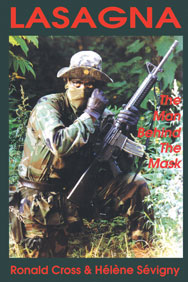
The events at Oka in 1990 saw the might of the Canadian Armed Forces in the service of the governments of both Quebec and Canada confront some 40 armed Mohawk “Warriors” who were defending their local community’s resistance against a further colonial encroachment on their native lands. The day after the military stand-off at Oka ended, “Lasagna,” one of the leaders of the Mohawks’ armed resistance, was “unmasked” as Ronald Cross—a man with no criminal record, no connections to the Mafia or any other “criminal underground,” and no military service record in Viet Nam or any other country in the world. Where, then, had these “common knowledge” rumours originated? This and other questions are explored in this biography.
Readers of ebooks will be happy to know that the ebook edition of this book has just been released!
9. The Hunting Ground by Lise Tremblay
(Fiction)
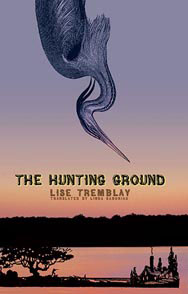
The Hunting Ground brings together remarkably engaging stories recounted by different residents of a northern Canadian village facing a gradual but devastating transformation.
10. Write It On Your Heart by Harry Robinson, edited by Wendy Wickwire
(Non-Fiction)

Write It on Your Heart is a celebration of the late Harry Robinson, one of the great storytellers of the Interior Salish people of North America. Collected over a ten-year period, the stories selected for this volume tell from a First Nations point of view about the origin of the world; the time of the animal people; the time before the coming of the white man; the stories of power; the prophet cult and its predictions of profound cultural and economic change; and the post-contact world.

Useful Links
Latest Bluesky Posts
Phone: (604) 444-4889
Outside Vancouver: 1 888 445-4176
Fax: (604) 444-4119
Website: www.talonbooks.com
Email: info@talonbooks.com
Talonbooks gratefully acknowledges the unceded, Traditional, and Ancestral Territories of the Coast Salish Peoples, including those of the xʷməθkʷəy̓əm, Sḵwx̱wú7mesh, and səlilwətaɬ First Nations, on which we are privileged to live, work, read, and write.
Talonbooks is thankful for the financial support of the Canada Council for the Arts, the Government of Canada through the Canada Book Fund, and the Province of British Columbia through the British Columbia Arts Council and the Book Publishing Tax Credit.




Copyright Talonbooks 1963–2026
If you have any questions or comments about this website, contact the webmaster.