
Reflections on Regionalism
by Megan Jones
Recently on Meta-Talon we highlighted three of Canada’s female short story authors in a deliciously patriotic little piece titled “Canadian Women Write Good Short Stories, Eh?” One of the authors whom we talked about (read: gloated about on behalf of all Canadians) was Lynn Coady, whose short story collection, Hellgoing, won the Scotia Bank Giller Prize in 2013.
Coady hails from Cape Breton, home to one of my favourite poets, the seasoned Don McKay – and before McKay there was the great Elizabeth Bishop, a powerful maritime literary influence, whose work at times dusts McKay’s own in a thin layer of sparkling fish scales. Coady’s win and the legacies of these two poets led me to explore another form of literary patriotism: regionalism.
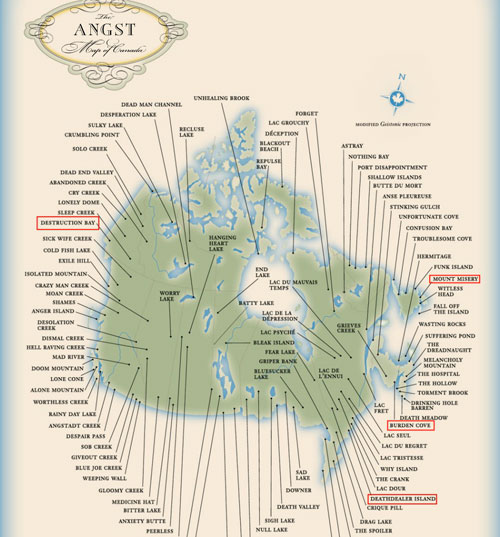
Above: the Geist Angst Map of Canada (from the delightful Geist Atlas of Canada )
Regionalism. Yes, that dreaded word. Negative associations cling to this word during periods when tensions between national and local politics are high. “Populate the West!” they said back in 1872. “It will be fun,” they said – but according to the Canadian Encyclopedia, the term “may [also] refer to the distinctive local character of different parts of the world or to a people’s perception of and identification with such places.” Sounds a bit more positive, doesn’t it? In the context of literature, the term can denote a text that reflects the customs, cultures, and landscapes of the region in which it’s set. Canadian literature pushes the term further, I think, utilizing it to identify a fluid commonality between the authors of a certain environment with regard to their writing style, content, characterization, or use of metaphor, symbol, and theme. To quote Northrop Frye, “What affects the [Canadian] writer’s imagination … is an environment rather than a nation. Regionalism and literary maturity seem to grow together.” [Italics mine.]
I’ve travelled in Cape Breton and have experienced the effects of the sprawling horizons dotted with bleached, clapboard houses, the roiling sea, the abandoned, seaweed-draped fishing boats, on the writer’s imagination. What I take from Frye’s criticism is that the writers of this region don’t replicate the landscape in the work; rather, the landscape itself molds the imagination of the writers and in turn shapes the form of their work. Great form, as we’ve all been told, mirrors content.
I am already reaching here for Newfoundland native Sandra Djwa’s biography of P.K. Page, which won this year’s Governor General’s Award, or fellow East-coaster Lisa Moore’s 2013 novel February, winner of the CBC Canada Reads prize.
But before I dig through the Talon archives to fan out a selection of our award-winning Maritime plays – colourful, streamlined, many exteriors having been modernized in the course of one or more reprints – I remember: last week, sitting in my car long after I’d parked, I listened as, on the radio, Katherena Vermette read from her lyrical and startling new book North End Love Songs, winner of the 2013 Governor General’s Award for poetry. When writing the poems, Vermette said, she was influenced by her home: Winnipeg’s eclectic and unfortunately derelict North End neighbourhood.
I recalled that the prairies now have their own International Writers Festival: THIN AIR, a September event in Winnipeg. According to one Talon author who spoke at this year’s festival, THIN AIR is incredibly well organized, well attended, and buzzing with an engaged and talented literati. With the exception of the persistent winds, he said to me over the phone, which were barely audible over the roar, it was a great experience.
I wondered: could I hear traces of wind in Vermette’s lingering poems? What about those of Canada’s poet laureate Fred Wah?
That author on the phone was Daniel Canty. Canty recently published a perfect (in my opinion) book of fiction called Wigrum, translated from the French by Oana Avasilichioaei.

Canty is perhaps more well known in Canada and abroad not for his fiction (though the book did win two awards) but for theatre and film – perhaps not a surprising overlapping of styles, considering that Canty’s region, Montreal, Quebec, is well known for its powerful and award-winning playwrights, like the venerable Michel Tremblay.
Canada, as we know, is a gigantic country that is becoming increasingly more concentrated in its urban centres. With great size and geographical/topographical variety comes a myriad different regions, each with its own community of writers with unique experiences, sensibilities, values, cultural backgrounds, and artistic influences. But Canada is also a multicultural mosaic that overlaps and intersects in a variety of colourful ways. Considering this modern diversity, what unites the literature of a region is, perhaps, nothing but the region itself: geography, culture, localized social issues, and political scandals (ahem).
At Talonbooks we are proud of Canadian authors, but perhaps as Rob Ford continues to damage our reputation as an intelligent and informed nation, we should recall our successes and bask in our best contributions to the world, which include quietly profound writers that dwell in far-off corners and dense urban hotbeds of this vast country. In the coming months on Meta-Talon, watch out for regular articles that explore Canada’s literary regions by putting the spotlight on some of the talented Talon authors who are inspired by and compelled to write within these geographical and aesthetic and social spaces.

Useful Links
Latest Bluesky Posts
Phone: (604) 444-4889
Outside Vancouver: 1 888 445-4176
Fax: (604) 444-4119
Website: www.talonbooks.com
Email: info@talonbooks.com
Talonbooks gratefully acknowledges the unceded, Traditional, and Ancestral Territories of the Coast Salish Peoples, including those of the xʷməθkʷəy̓əm, Sḵwx̱wú7mesh, and səlilwətaɬ First Nations, on which we are privileged to live, work, read, and write.
Talonbooks is thankful for the financial support of the Canada Council for the Arts, the Government of Canada through the Canada Book Fund, and the Province of British Columbia through the British Columbia Arts Council and the Book Publishing Tax Credit.




Copyright Talonbooks 1963–2026
If you have any questions or comments about this website, contact the webmaster.