
In the Lil’Wat Footsteps of Charlie Mack: An Interview with Trekker Brian Couche
Educator Brian Couche was recently interviewed by Chloë Filson of Talonbooks about his Fall 2012 trek through the wilderness of British Columbia with a young companion. In this interview, Brian wields his considerable power as a storyteller to share personal challenges and anecdotes from their twenty-seven-day journey.
(All photos are by Brian Couche and Shea Whalen, unless otherwise stated.)
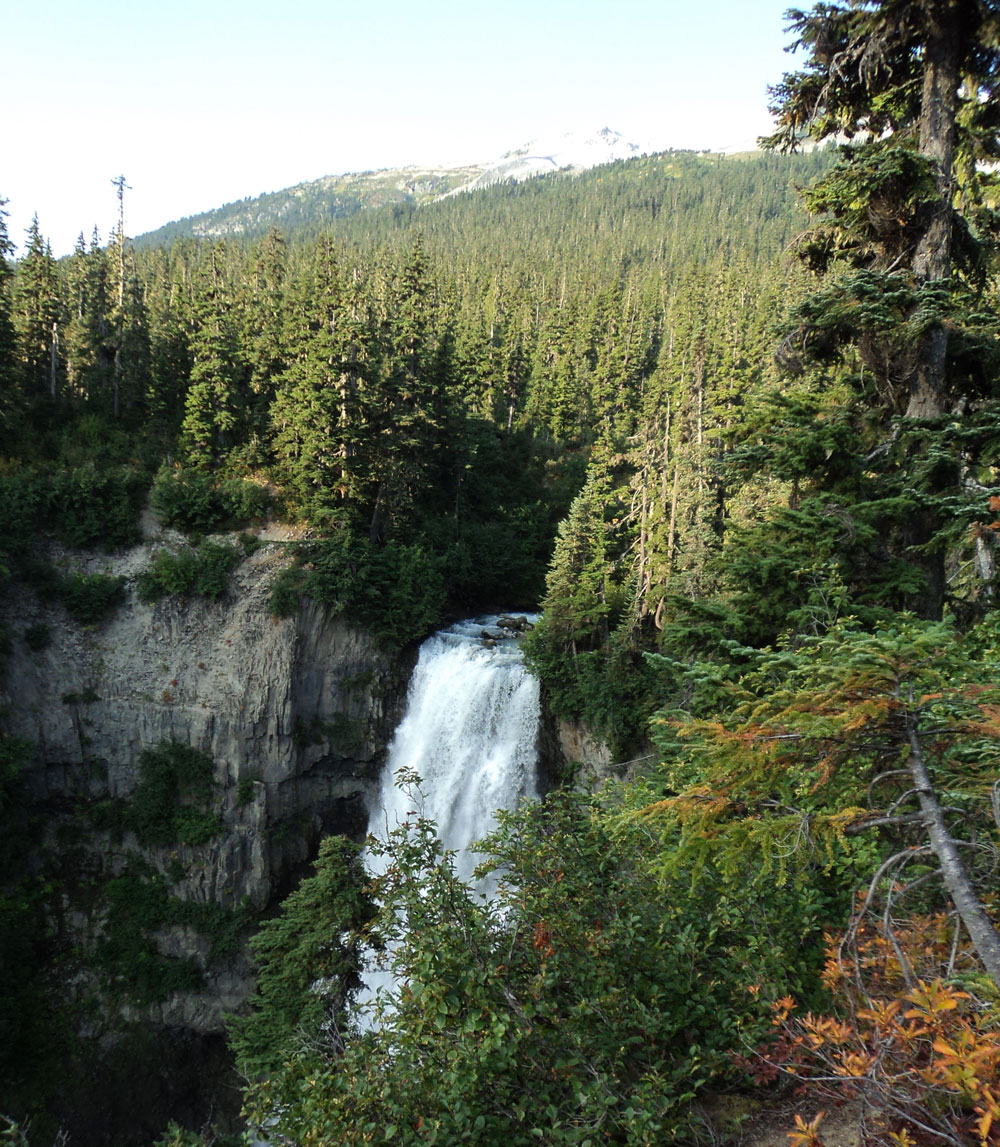
Above: A waterfall and surrounding landscape viewed by Brian and Shea
Talon: Tell us a bit about your expedition. Where did you go, and why? Who did you hike with?
Brian Couche: We began our journey upstream from Pemberton Meadows, setting off on September 10, 2012, at 4:20 p.m. precisely (we had synchronized our watches with the 10:00 a.m. National Research Council Time Signal heard on CBC Radio that morning) – two city slickers with limited backcountry wilderness experience seeking to retrace the footsteps taken thirty-five years earlier by my dear friend Russell Letawsky, who I met at the historic Lund Hotel at “beer o’clock” and who some call the Hermit of Desolation Sound. Russell, in turn, in a sense, had been retracing the steps of Charlie Mack.
In many ways, Russell reminded me of my father – well read, experienced, and adventurous, full of tales and a thirst for knowledge. While Russell may seem cantankerous to some, for me it was like having my own private professor of life. I enjoyed listening to Russell’s tales of adventure. Long before Shea and I ventured out, I had come to know the route like the back of my hand; I had listened intently to Russell talk about his trek, asking many questions and memorizing the knowledge of every rock, turn, and obstacle along his route. I also studied Russell’s collection of maps and photos.
As for why I made this journey, while some people write about adventure, others live adventure. Since I’m not a writer, I am doomed to live an adventurous life. While Grant Lawrence honoured Russell in his acclaimed book Adventures in Solitude (Harbour Publishing, 2010), I honoured our mutual pal by retracing his footsteps.
I was accompanied by a friend’s fourteen-year-old son, Shea, who I met at his father’s place while making my way to the airport for a flight back to Vancouver. I had just spent five days with Russell, making final preparations, gaining confidence, and acquiring knowledge for the journey ahead. All my other options for trekking companions had failed to materialize; in less than a week I would depart on my own if I did not find a companion. So I asked Shea if he was interested, promising the adventure of a lifetime. Shea’s father gave his approval immediately, for he saw the intrinsic benefits that this experience would have for his son. Just two days before my scheduled departure, Shea’s participation was confirmed; his mother had approved, and his school principal had agreed.
For Shea, the trek bore a likeness to Outward Bound and other wilderness education programs. We explored geology, botany, astronomy, and photo-journalled our time. We both learned the importance of team-building. We also took time to reflect on what the area must have been like a long time ago, in the time of Charlie Mack’s ancestors.
We set out to challenge our imaginations and test our physical stamina, but the mental and emotional challenges would prove more intense and more lasting. Despite his inexperience, in many ways Shea was my security blanket. His presence forced me to be brave and overcome my fears in order to protect him from harm. Since his safety was paramount, I found I could supress my fear by focusing my senses on the harmonics of the wilderness and choosing the right path. In other words, I told myself: “Listen to your Spidey senses, find a safe route, and, in no uncertain terms, bring Shea back alive.”
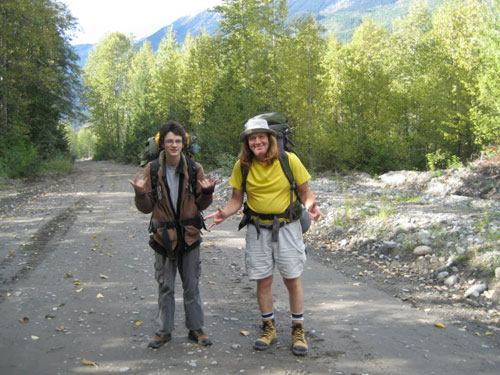
Shea and Brian at the beginning of the trek
Shea and I followed the Lillooet River northwest toward its confluence with Meager Creek. All we had to do then was make a left and follow the Meager to its headwaters, over Mount Meager and down the other side to Toba Inlet and we’d be home! As the crow flies, the distance was 120 kilometres, but with all those twists and turns, ups and downs, we traversed over 242 kilometres from start to finish. It was our way of paying tribute to Russell and homage to the memory of Charlie Mack and the Lil’wat people of yesteryear.
[See a map of the trekkers’ route here.]
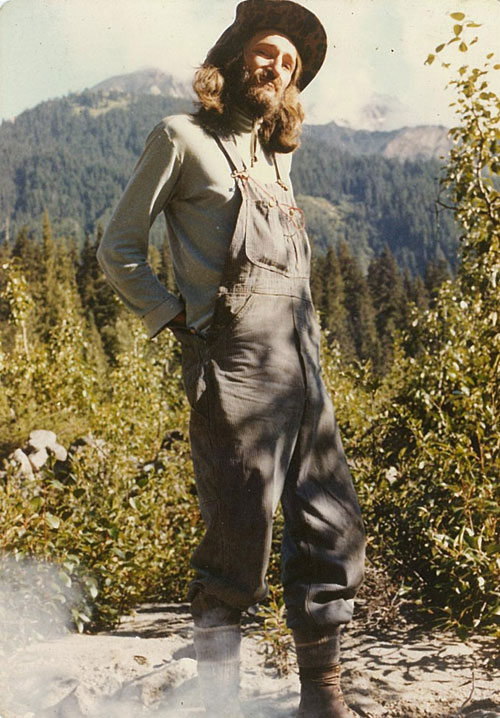
Russell Letawsky, looking toward the East Toba Valley during his Meager-to-Toba trek in 1977
Talon: We hear you brought a knife as protection, but not a gun – how brave! We also hear you read the book The Lil’wat World of Charlie Mack by Dorothy Kennedy and Randy Bouchard (Talonbooks, 2010) to help you prepare. How did Charlie Mack, the Lil’wat (or Lillooet) storyteller featured in the book, figure into your trek?
BC: There is something to be said about strength in numbers. I knew that Shea and I could be a formidable force in the event that we needed to defend ourselves – we’d be able to ward off unwanted guests – but, unlike Russell and others with high-powered rifles, it was our intent to employ pre-firepower tactics, as the earlier peoples of the land had done: animal awareness, avoidance, co-existence, and harmony.
Of particular relevance and joy to me (a tall, red-headed guy) is the story of the shaman, the elders, and the HaitLólaux (Tall Redhead): in Lil’wat legend, long ago, it was the tall redheads who walked in the mountains and who joined with the Wolf to create the Lil’wat people. (See page 34 of The Lil’wat World of Charlie Mack.) Add to the mix the fact that I am one-eighth Ojibwa (my maternal great-grandmother).

More powerful than any lethal weapon are the guidance, wisdom, and spiritual blessings of elders – and it doesn’t hurt to have a shaman in your corner. These human resources are often overlooked, but I sought their spiritual guidance prior to the trek. Just imagine what the Lil’wat elders thought when they first laid eyes on me, a HaitLólaux, when I sought their guidance, wisdom, and blessings; I stood right in front of them while they learned of our plans to walk among the trees and above, and to walk down again.
Prior to our departure, the shaman called upon the “spirit bear” to look over us during our adventure and said it was the bears’ responsibility to remind all animals to respect our rite of safe passage. Our serenity prayer to Mother Earth and Father Sky sure came in handy. We had visitors only one time: a bear and her cubs paid our campsite a visit late one night. As I laid there motionless in the tent, holding my breath for what seemed an eternity and clutching my buck knife, I recited a serenity prayer in a muted voice with our action plan running through my head. As quickly as all three bears urinated, they were gone. All I remember is lying there motionless in the tent, willing myself not to move, and trying to calm my racing heart, but Mother Nature was calling and I had to go! “Shea, get up.”
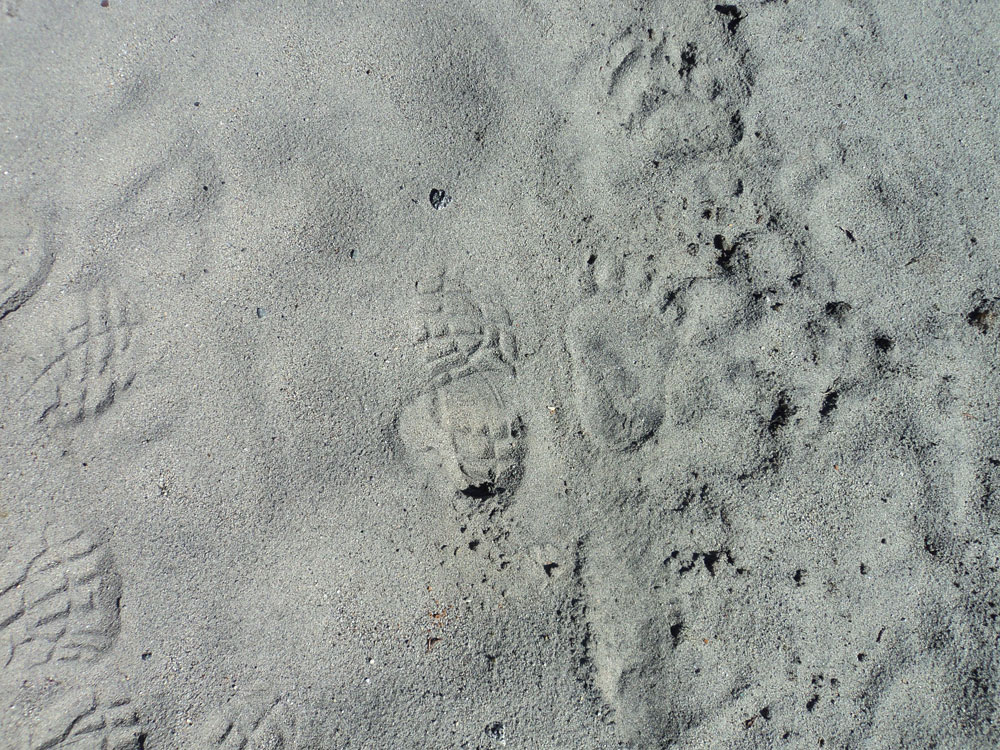
A constant reminder of the importance of co-existence and mutual respect among all species of animals. (Meager Creek, B.C.)
Unlike our friend Russell, we didn’t take an M1 rifle with a twenty-odd round clip, nor did I have a thirty-year old female companion. On the other hand, we had an arsenal consisting of only two pocket knives, two canisters of bear spray, eighteen rounds of bear bangers (fireworks shot into the sky to scare off bears), and a six-inch buck knife. What we lacked in armaments we made up in smarts. A firearm was way down on my list of priorities, and I even find a hiking stick cumbersome, though we always had two close at hand and near our tent every night. Quickly securing a knife to the end makes a formidable weapon.
Who in their right mind would stick their head deep into the wilderness, unarmed and alone? If daytime wasn’t difficult enough, what about when night set in? It is in the blackness of night when all those nocturnal animals come out to hunt: black bears, wolves, cougars, and the ferocious and carnivorous grizzly. I personally wasn’t prepared to run into this undisputed champion of the forest. It is only because of firearms that humans sit atop the food chain. We hoped to avoid chance encounters with grizzlies hoping to reclaim the title.
Other than chipmunks, squirrels, some birds, a salamander, and one hawk, we neither came across nor saw any wildlife whatsoever. However, there were signs of fresh paw prints all around us wherever we went. I’ll never forget the feeling upon seeing my first grizzly paw print of the trek – and fresh scat, too!
Though my heart sank at that, I suggested that it might be a good idea, as we walked, to recite our prayer to Mother Earth and Father Sky to grant us safe passage. It was Shea’s idea to add Father Sky. He asked if it would be okay, to which I replied, “You can’t be a Mother without a Father!” We decided this: while Father Sky is everywhere around us and in us, it is Mother Earth who gives us life and nourishment.
We gave thanks every day before bed. Our prayer has become a daily ritual.
For twenty-seven days, Shea was a captive audience for our surroundings. Since we were travelling unarmed, one suggestion of the elders was to talk to the animals in a calm, relaxed voice. If animals can sense fear and weakness, they can also sense strength.
I did as instructed and declared our presence throughout the trek. From the first step to the very last twenty-seven days later, I said “hello” every 50 to 60 metres. Saying “hello” gave me a feeling of security. I didn’t want to surprise any animal. The twitch of a head or flick of a tail was enough to forewarn me of lurking danger. At times we fought your way through thick brush, not knowing what lay in front of us or what lurked around a bend. It’s not easy navigating a thick wall of evergreens that obscures the route ahead, fighting for every inch of the way. I personally didn’t want to surprise a cougar or grizzly bear, especially a mother with her cubs! Would anyone?
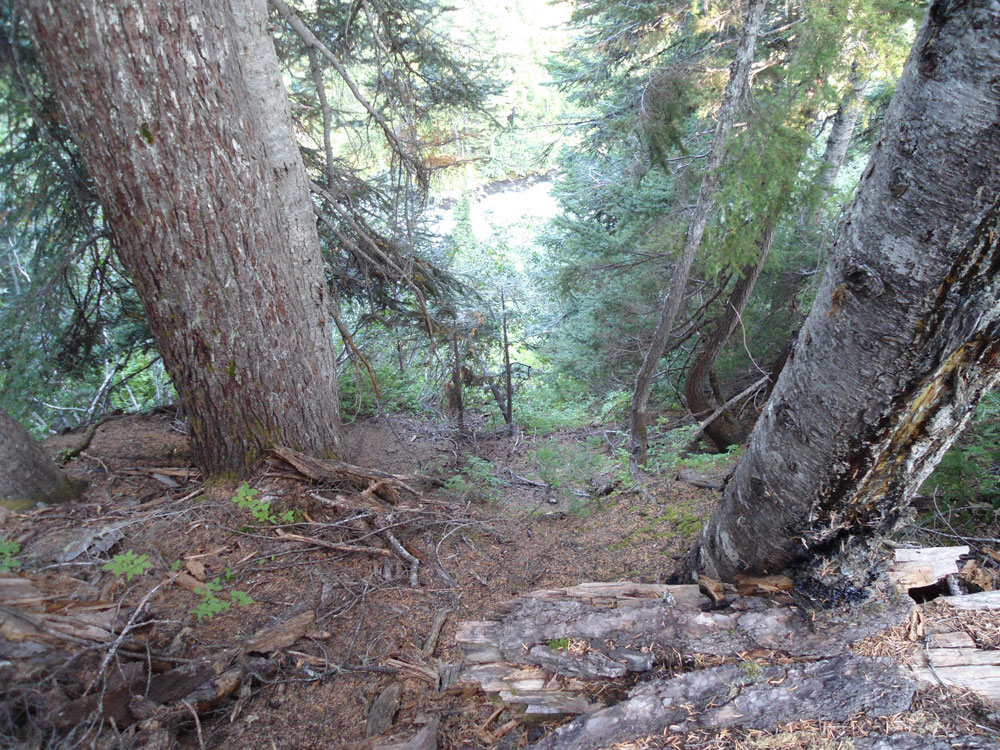
Thick evergreens mask treacherous terrain
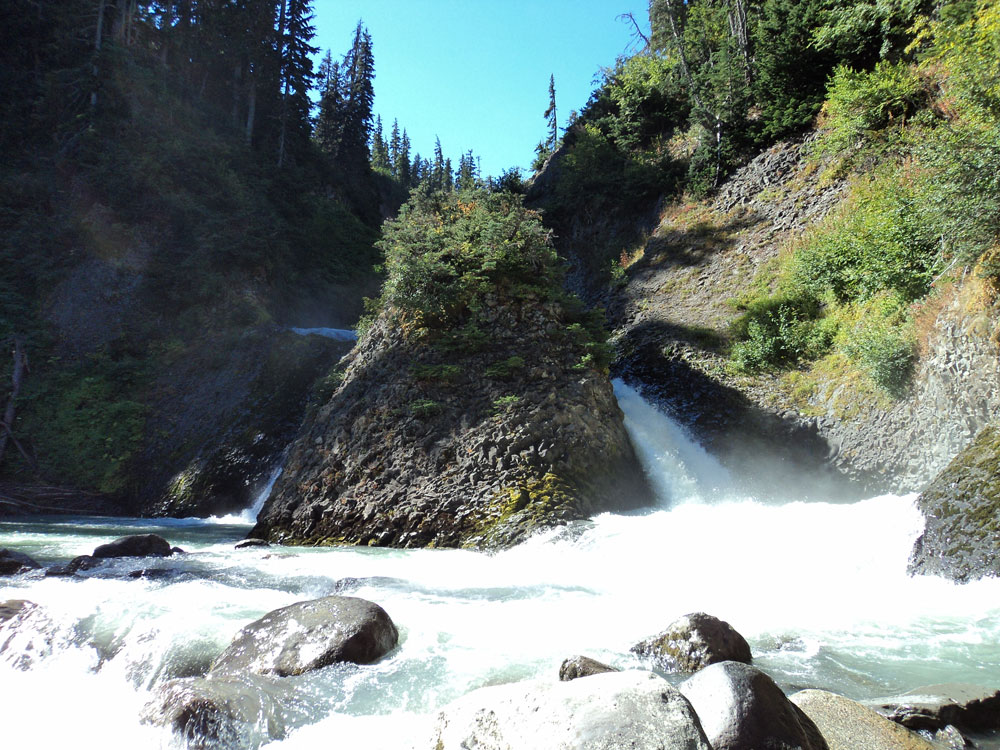
Brian and Shea came upon a pair of waterfalls. “We followed a trail that led us to the first waterfall. It was a path through tall grass that had been parted to make a path for some large animal. It was difficult going on this day. Shea was determined to climb the steep embankment with its wet, slippery surface, which made progress slow and dangerous. In all, we progressed forward less than three kilometres.”
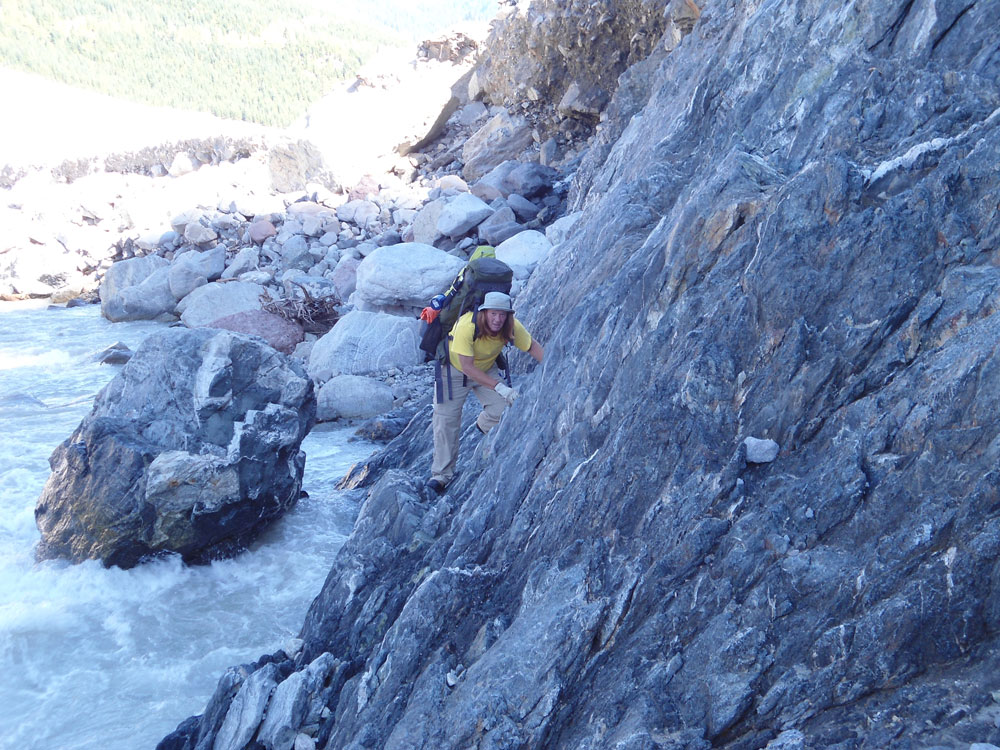
Brian negotiates the rock face near the confluence of Meager Creek and Capricorn Creek, where on August 6, 2010, 48.5 million cubic metres of debris slid down the Capricorn Glacier in what was possibly the largest landslide Canada had experienced in recorded history. (See coverage from The Tyee for more detailed information, and view aerial photographs by D.B. Steers.)
The effects of the 2010 Capricorn Creek landslide transformed the area where the Meager Creek and Lillooet River meet into a virtual moonscape. It presented an impenetrable wall of trees, boulders, and mud 5 to 8 metres thick. The sheer volume of rocks, boulders, and trees washed upwards of 270 metres above the valley floor. The force of nature produced a deflection 3.7 kilometres upstream and 4.9 kilometres downstream into the Lillooet River Valley. The slide deposited fine, powdery sediment over the entire area. When moist, it acts like quicksand. It was extremely treacherous along the water’s edge.
We followed Meager Creek past the landslide. Every step was perilous. The danger of being washed away by the raging Meager below and the thought of being pounded against the boulders like the ball in a pinball machine presented a constant danger which required our fullest attention. Walking was a struggle, each footstep being sucked deeper beneath the surface. After assessing the situation, we decided to begin further downstream along the Lillooet River on the southeast side and work our way upstream to the Meager. After a full day of trekking, we finally crossed the Meager and onto the west side at the 6 kilometre marker.
Anyone attempting to traverse this area – including Charlie Mack – would surely have had to follow a similar route and encounter similar dangers.

Brian and Shea look back at Beluga Peak from their campsite after crossing into the Toba River Valley
After a hard day’s journey, Shea and I would relax around a fire or in the tent before bedtime. We’d tell stories, play cards, read up on Nietzsche, reflect on the day’s events, or think about what might lie ahead. Sometimes we would animate our stories by making shadow puppets on the tent wall using our headlamps or the light cast by the fire. I attempted to relay the history of the Lil’wat and First Nations people by making us both think about how they lived, so long ago, without modern technology. What route did they take? What was their civilization like? Not only did I want Shea to reason things out and use his imagination, I wanted to be tested and learn too. Every day was an accomplishment, another obstacle overcome.
Not only was I responsible for Shea’s well-being and safety, I offered him the opportunity to learn more than he might have if he had been in school. Who wouldn’t want to get out of school for six weeks and have the adventure of a lifetime? The way I looked at it, Mother Nature was both our playground and our classroom, while Russell and the Lil’wat, Klahoose, and Sliammon peoples were our teachers. It was up to us to learn and endure.
Some sound advice was offered by an individual who had plenty of experience eluding the authorities for prolonged periods of time and living completely in the wilderness. “You can eat any leaf or flower – except those that are yellow.” Since we were not hunters but gatherers, this proved to be excellent advice. Mother Earth shall nourish us, we knew; it was just a matter of learning what was edible and what was poisonous. As anyone would have, we feasted on blueberries, blackberries, salmonberries, and leaves. We experienced a forest delicacy: the mushroom known as ”Chicken of the Woods” along with a leafy plant similar in taste and texture to spinach (Valeriana scouleri). At first, Shea expressed his displeasure and distaste for spinach, but he quickly learned to love it. It was best when mixed with our special spice mixture. (Turmeric is a must; not only does it add to flavour, it is an excellent anti-inflammatory.)
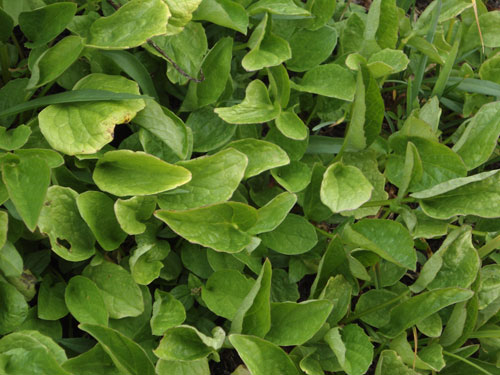
Valeriana scouleri, a leafy plant similar in taste and texture to spinach. We found this plant purely through trial and error. Whether eaten raw or steamed, it had a pleasant taste with no deleterious effect on our regularity.
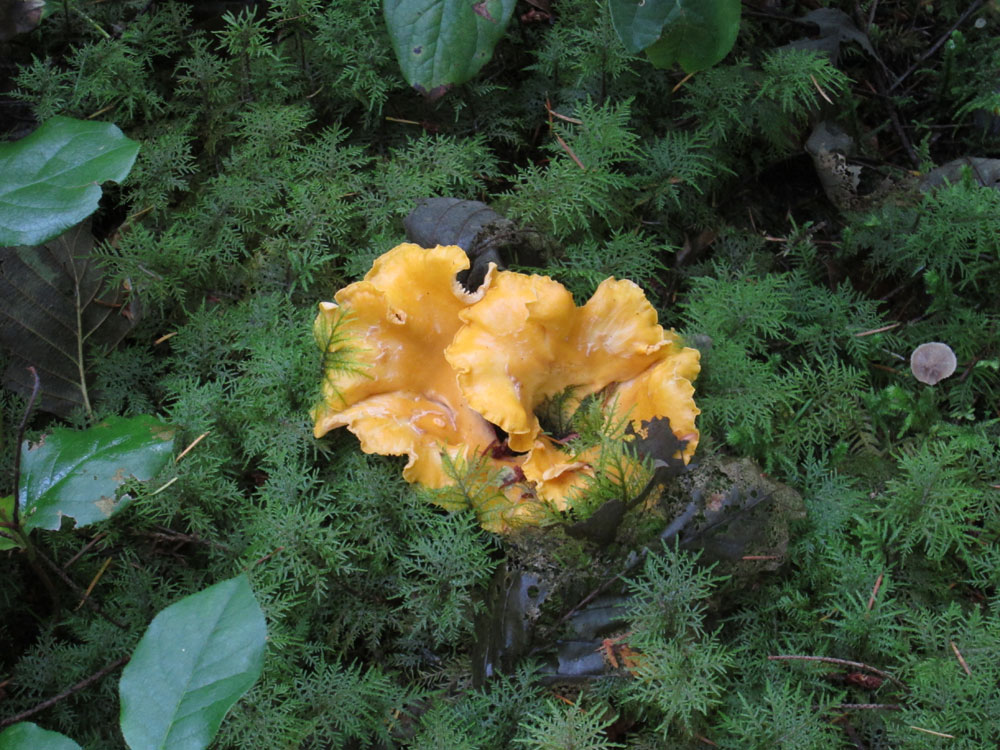
The Chanterelle mushroom (Toba River Valley)
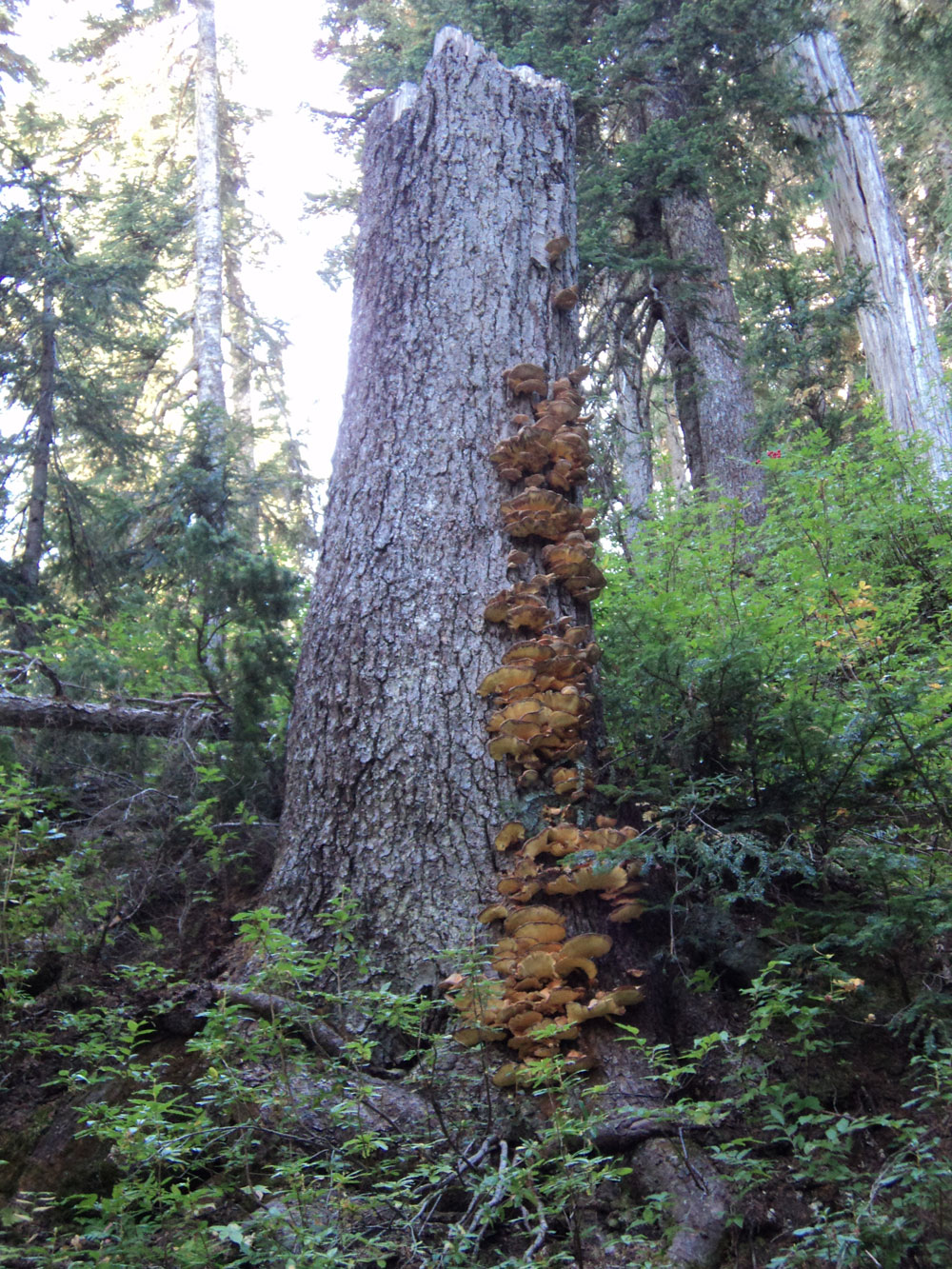
Laetiporus sulphureus (or Chicken of the Woods)
One of the parameters of this adventure was that one third of our sustenance had to be derived from the forest. I didn’t wish to bring a firearm because of my fear that I would either shoot myself in the foot or be beside myself after killing an innocent animal. We were in their territory, and were just passing through. After twenty-seven days of eating nothing but purely organic food harvested from the bounty of Mother Earth, Shea and I were the healthiest we had ever been or may ever be; we were cleansed of toxins and in good shape.
For me, this trek was an opportunity to achieve a lifelong goal: to hike across the mountains just as the Von Trapps had crossed the Alps in The Sound of Music. The first time I saw that movie, as a kid, I fell in love with the mountains. Seeing those opening and closing scenes sealed the deal: I was going to hike over the mountains and through alpine meadows.
Skip forward forty-four years. Time was running out. It was now or never. All I needed was a trekking partner …
“If Russell could do it, than so can we,” I told Shea as we set off.
In retrospect, I’m glad Shea accompanied me. It would prove to be the journey of a lifetime. I am very proud of Shea. He achieved where a lesser person would have turned back. For twenty-seven days, we bushwhacked through old-growth forest, scaled treacherous mountain terrain, rappelled steep valleys, and crossed raging, swollen creeks. A big debt of gratitude goes out to Shea for helping me realize one of my life’s goals.
Talon: Mentorship seems to have played an important role in your adventure: you set out to retrace the steps your own mentor, Russell Letowsky, had taken thirty-five years earlier; and you acted as a mentor to Shea along the way. Did Charlie Mack or the book, The Lil’wat World of Charlie Mack, inform these mentorships in any way?
BC: On the second day of our trek, Shea informed me that he wished to go back – to quit and go home. “What about me?” I asked. In a way, I became a shape-shifter, transforming myself into what must have seemed to Shea a sergeant major barking encouragement. “WHAT, QUIT?” What I attempted to impart to Shea was this: while we may follow in the footsteps of others before us, we walk in no one’s shadow. This was our trek, our adventure, and our choice whether to succeed or fail. In other words, I read Shea the riot act, telling him that if he wanted to go home, it was shorter to go forward than to turn back.
Some people expected us to fail. Russell himself thought that I was too inexperienced. Others assumed we would either chicken out (not go at all) or turn back at first fright. We sure fooled them and proved a lot to ourselves in the process; anything is possible as long as one is willing to wholeheartedly engage their mind, body, and spirit. Besides, we wanted to see the expression on the naysayers’ faces when we emerged from the wilderness.
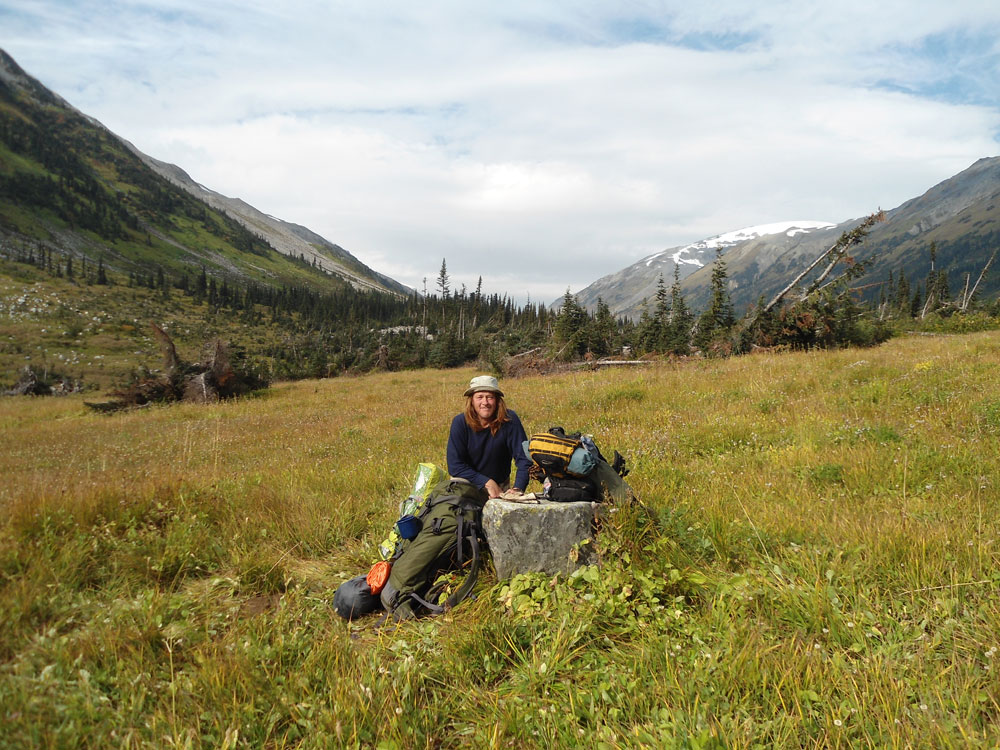
Brian and Shea find a rest stop along the way.
During our evening storytelling sessions, I would tell Shea more about my experience with the elders, the shaman, and with Russell. I mentioned how in my dream the spirit bear stood on the crest of the mountain and gave a mighty roar, resonating throughout the Toba Valley, signally our crossing and reminding others, granting us safe passage. As we crossed over the top and entered into the Toba Valley, both Shea and I found ourselves looking back toward the mountain ridge, thinking of Russell and Charlie Mack. The mountains emit myriad distinct sounds, but we know what we heard: it sure sounded like the roar of the spirit bear. We are believers, for we are here to tell the story, unscathed, in one piece.
From the elders and shaman I sought only guidance and safe passage. We would sustain ourselves with whatever we gathered from the forest and water; all we asked was for a celebratory grouse dinner once we accomplished our trek. For twenty-seven days we spoke of how we would cook the grouse and what type of berry sauce would go best with it. We must have cooked and recooked that grouse more than a hundred mouth-watering times. Lo and behold! A grouse appeared from the forest at the 1.5 kilometre mark – the end of the road!
“Brian, Brian!” Shea said in a low, hushed voice. As I turned, he pointed straight at it. “Dinner!” Was it a coincidence or had the shaman sent the grouse as a reward for our accomplishment? Either way, we missed the grouse with our stones and it flew back into the safety of the forest, looking at us from a safe distance in the trees, taunting us. If there was any consolation, it was this: as we emerged from the wilderness and enjoyed the hospitality provided by Alterra Power Corp (which put us up for the night in its floating camp – a converted B.C. Ferry moored 50 kilometres downstream), Shea and I feasted on chicken wings – a symbolic gesture to the grouse and our accomplishment.
The hot shower and clean clothes were a real treat, and we were permitted to call home. While Shea called his mother, I called Russell to let him know that we made it. His voice trembled with joy upon learning of our accomplishment; we had “walked the talk”! We returned to Powell River by water the very next day – Thanksgiving Day – as accomplished adventurers!
Talon: What insights did you or Shea gain along the way? How do you speculate that Charlie Mack might have responded to the same experience, or to the insights you gained?
BC: Other than organized campsites and some off-road camping, I was new to this backcountry wilderness camping stuff, but I welcomed the challenge. It wasn’t the physical demands that lay ahead, nor the logistics, nor even the fear of getting lost that scared me. It was my state of mind. I had never been in there alone, and neither had Shea.
The difference between fear and danger is that fear is a state of mind while danger is reality.
We adopted the motto, “There is only one direction we take, and that is forward.” To turn back was to quit, and quitting is for losers! No matter how insurmountable the obstacle may seem, there’s always a way to overcome it.
Another parameter of our trek was to observe man’s intrusion upon the splendour of untouched wilderness and the effects (if any) of climate change. What I came away with is: the beauty of Mother Earth isn’t boundless, and we need to do more to preserve what she has to offer. (A case in point is that Russell and his companion, in 1977, trekked approximately eight kilometres over a glacier to the other side, while Shea and I, in 2012, walked between the remnants of what was left of that same glacier.) We must use our knowledge for the betterment of the world for the generations to come. We saw hope for the future demonstrated in reforestation initiatives and the impressive run-of-river generation station. Humans can learn to co-exist with Mother Nature, and some things are best left undisturbed.
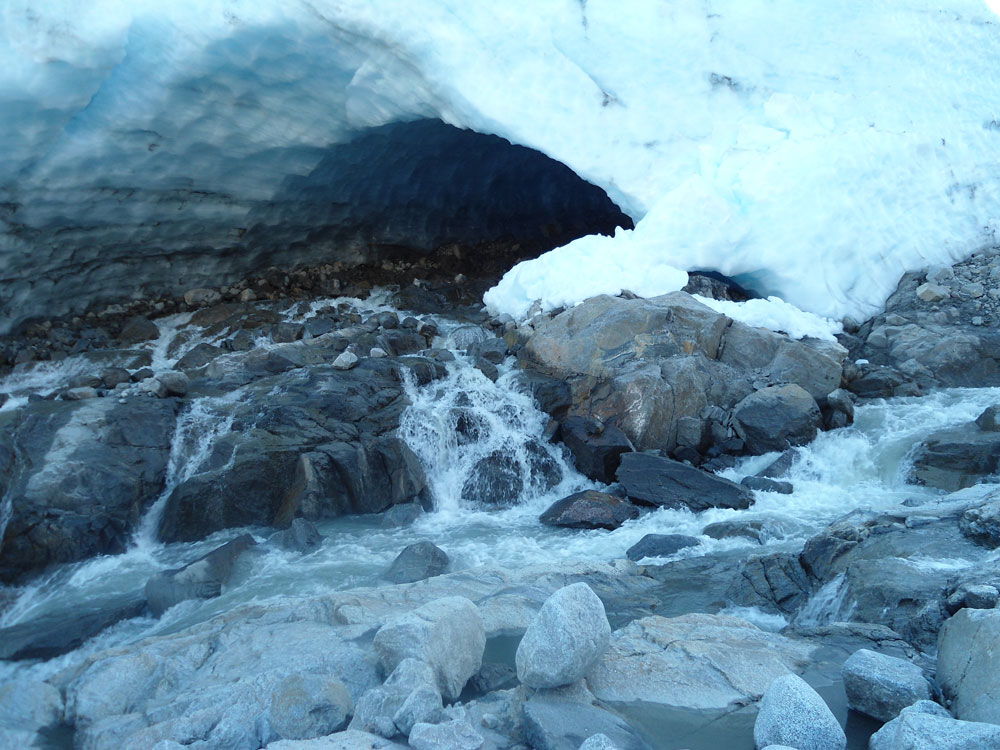
Ice caves in what remains of the Meager Glacier
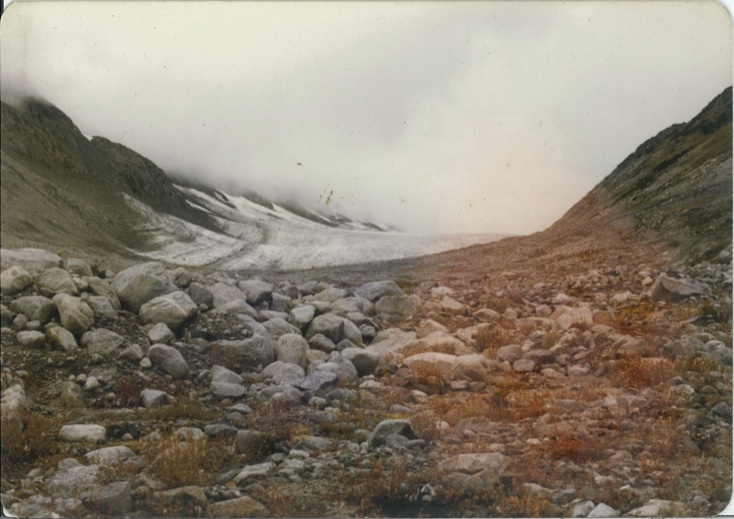
Approaching Meager Glacier, 1977 (photo by Russell Letawsky)
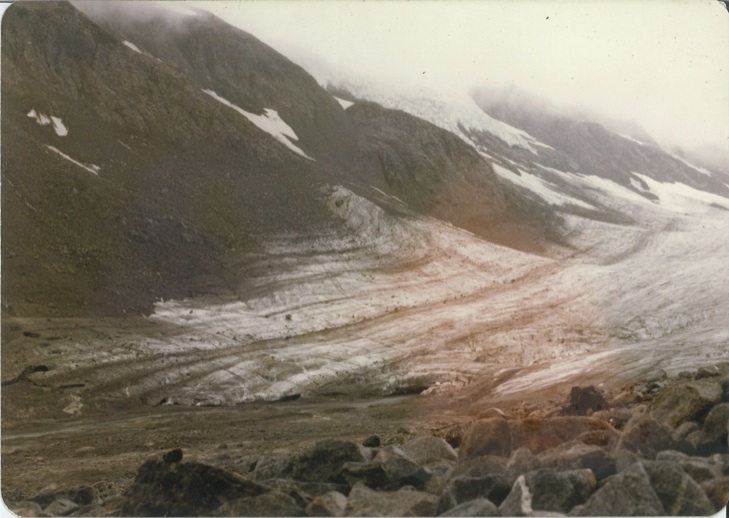
Approaching Meager Glacier, 1977 (photo by Russell Letawsky)
What we learned from Nietzsche was: Don’t let indecision be your amor fati. If you want something bad enough, then go out and earn it, but don’t forget to enjoy the journey.
During our trek, we left our personalized calling card, signed “amor fati” (from Latin: acceptance or “love of fate”) in honour of Russell. We hope others who follow will respect Mother Nature, leaving only a small footprint too.
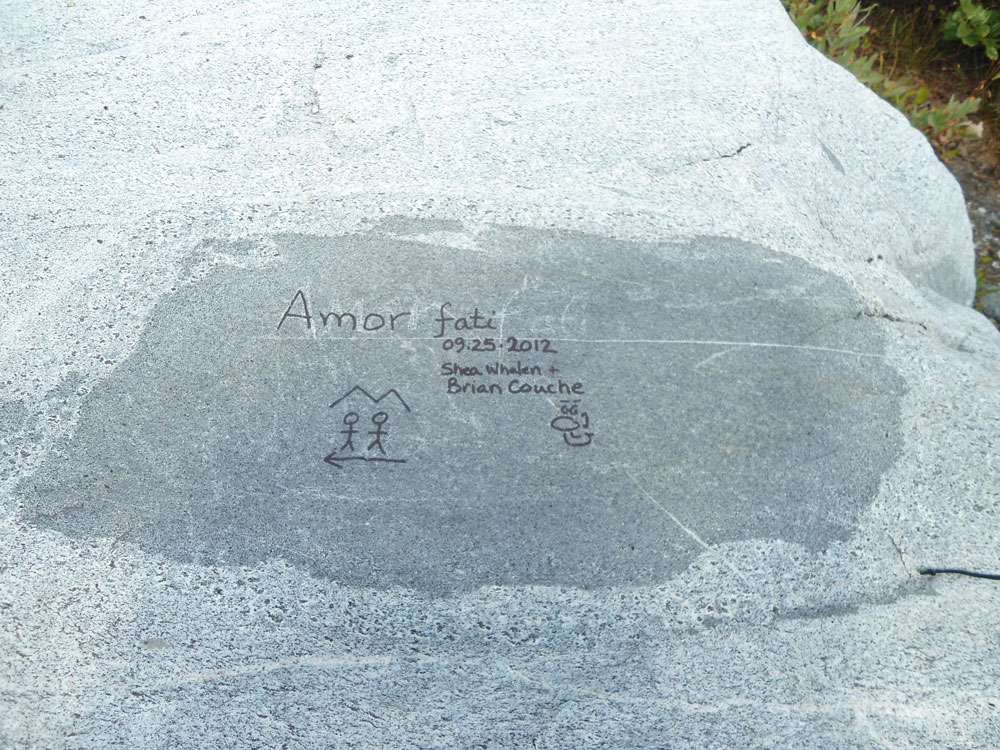
Brian and Shea’s calling card
No matter their socio-economic background, all youth are “at risk,” especially from peer pressure. Every individual will come to their own “fork in the road,” facing life-changing choices and consequences. Perhaps, for Shea, this trek was one of those turning points. I have learned from his teachers and principal that, since our trek, Shea has demonstrated a greater degree of confidence in his abilities and is more engaged in school. He has also taken a more proactive role in his home in terms of showing respect to his mother.
Many outdoor education programs are available and highly recommended. I have plans with Russell to offer a more formal program of holistic spiritual wellness, in which youth will have access to mentoring, help with their studies, international dialogue with one another, and outdoor adventure. It is my belief that nothing soothes the soul and reinvigorates the spirit better than nature. Russell concurs.
I don’t know what Charlie might have thought, but I know what he must have felt, looking back down the valley from atop the mountain ridge. Comparing memories from his youth and his old age must have been difficult. Shea and I saw Mother Earth in all her grandeur and Father Sky illuminating our way with sunshine and twinkling stars at night – a playground and a classroom all our own.
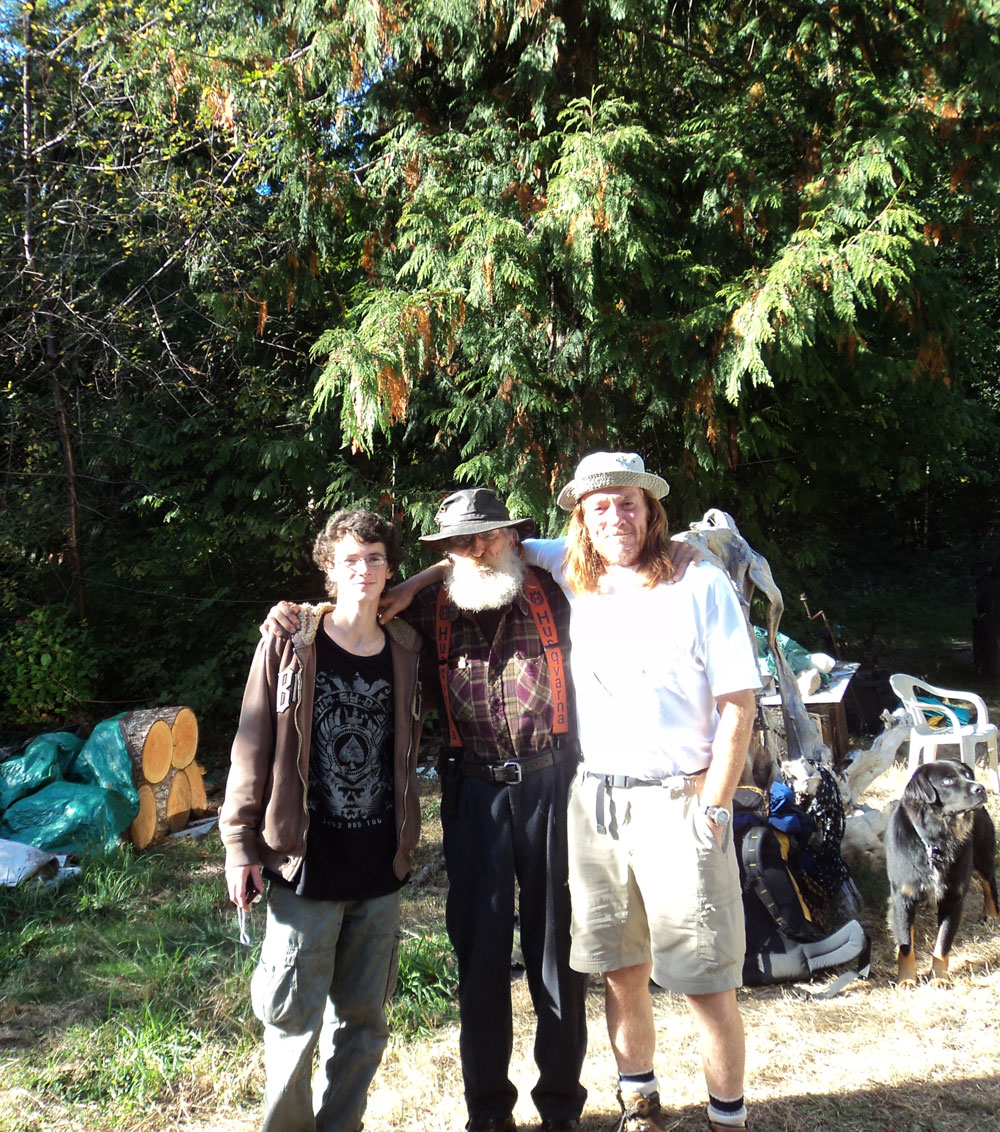
Shea Whalen, Russell Letawsky, and Brian-Desmond Couche, who each in their own time completed the 242-kilometre trek through untamed wilderness across the Coast Mountains

Useful Links
Latest Bluesky Posts
Phone: (604) 444-4889
Outside Vancouver: 1 888 445-4176
Fax: (604) 444-4119
Website: www.talonbooks.com
Email: info@talonbooks.com
Talonbooks gratefully acknowledges the unceded, Traditional, and Ancestral Territories of the Coast Salish Peoples, including those of the xʷməθkʷəy̓əm, Sḵwx̱wú7mesh, and səlilwətaɬ First Nations, on which we are privileged to live, work, read, and write.
Talonbooks is thankful for the financial support of the Canada Council for the Arts, the Government of Canada through the Canada Book Fund, and the Province of British Columbia through the British Columbia Arts Council and the Book Publishing Tax Credit.




Copyright Talonbooks 1963–2026
If you have any questions or comments about this website, contact the webmaster.