
Jean Barman’s Observations on They Called Me Number One
By Jean Barman
Co-editor of Indian Education in Canada: The Legacy and The Challenge, First Nations Education in Canada: The Circle Unfolds, and Indigenous Women and Feminism: Politics, Activism, Culture
Over the past quarter century, I have been asked many times by students and others to recommend a book that speaks honestly and straightforwardly to the residential school experience in British Columbia and in Canada more generally. My long-time choice of Shirley Sterling’s My Name Is Seepeetza, written from the perspective of a child, now has a fine counterpart in Bev Sellars’s They Called Me Number One, crafted with the wisdom of hindsight.
In May 2013, I had the privilege of attending Bev Sellars’s book launch in Vancouver where her emotion was palpable as she introduced the content to a large audience caught up with her words. Rushing home to read my just-bought copy, I was swept away. They Called Me Number One’s readable text lets the raw power of the story come through loud and clear.
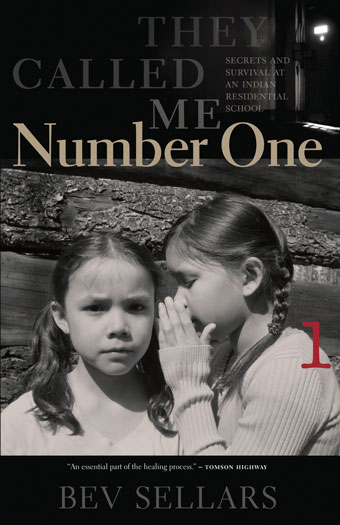
Very importantly, Bev Sellars integrates the residential school experience into her whole life. As a historian of British Columbia, I have been long intrigued by Missourian Jim Sellers, who is said to have made the first gold strike in the Cariboo in 1859 and began a family two years later with a Soda Creek woman named in the Catholic records as Rose Sitketza; however, I knew little about his descendants until I read They Called Me Number One. Bev Sellars was closest to her Carrier grandmother, Sarah Sam, whose French grandfather was another of those illusive newcomers who came and all too often soon went, leaving the indigenous women with whom they partnered to manage as best they could. Sarah Sam, whose resourcefulness Bev Sellars evokes with poignancy and intimacy, was herself a residential school survivor, just as would be the granddaughter she raised. At age five, Bev had to be sent away to a sanitorium to treat her tuberculosis. Three weeks after returning home twenty months later, she was taken away to residential school. Her five years at St. Joseph’s Mission, outside of Williams Lake, she endured due in good part to brief happy holidays with her extended family.
We follow Bev Sellars into her teens with all the discrimination and racism still marking the very slowly changing British Columbia of the late 1960s and 1970s. Despite being permitted to attend the public high school in Williams Lake, indigenous children were not allowed to ride on the same buses as “the White kids,” and so it went. Bev’s grandmother continued to be her principal support as Bev began a family of her own and variously made her way off and on the reserve. It was in her mid-twenties that Bev began to take charge of her life to become, in due course, a lawyer and chief at the same Soda Creek trod by her long ago ancestor Jim Sellers.
The direct writing style of They Called Me Number One makes it accessible to readers of diverse backgrounds and ages. Precisely because the book is a first-person account, we know the author survived to testify to the events she describes. We thereby truly come to understand what it has been to be an Indian in British Columbia, and why it was so long that way. They Called Me Number One is from my perspective necessary reading across the generations.

Useful Links
Latest Bluesky Posts
Phone: (604) 444-4889
Outside Vancouver: 1 888 445-4176
Fax: (604) 444-4119
Website: www.talonbooks.com
Email: info@talonbooks.com
Talonbooks gratefully acknowledges the unceded, Traditional, and Ancestral Territories of the Coast Salish Peoples, including those of the xʷməθkʷəy̓əm, Sḵwx̱wú7mesh, and səlilwətaɬ First Nations, on which we are privileged to live, work, read, and write.
Talonbooks is thankful for the financial support of the Canada Council for the Arts, the Government of Canada through the Canada Book Fund, and the Province of British Columbia through the British Columbia Arts Council and the Book Publishing Tax Credit.




Copyright Talonbooks 1963–2026
If you have any questions or comments about this website, contact the webmaster.